Maruti Suzuki has launched the 2026 Baleno facelift in India, with prices starting at ₹6.1 lakh. The updated premium hatchback brings a refreshed exterior, several new cabin features and a significant mechanical change under the bonnet.
While the overall design and proportions of the Baleno remain familiar, Maruti Suzuki has made several important changes to keep the hatchback competitive in a segment that includes models such as the Hyundai i20, Tata Altroz and Toyota Glanza.
The biggest talking points of the new Baleno are its Level 2 ADAS technology, ventilated front seats, upgraded cabin equipment and new three-cylinder Z-Series petrol engine.
Here’s a closer look at everything that has changed on the 2026 Maruti Suzuki Baleno facelift.
Refreshed Front-End Design
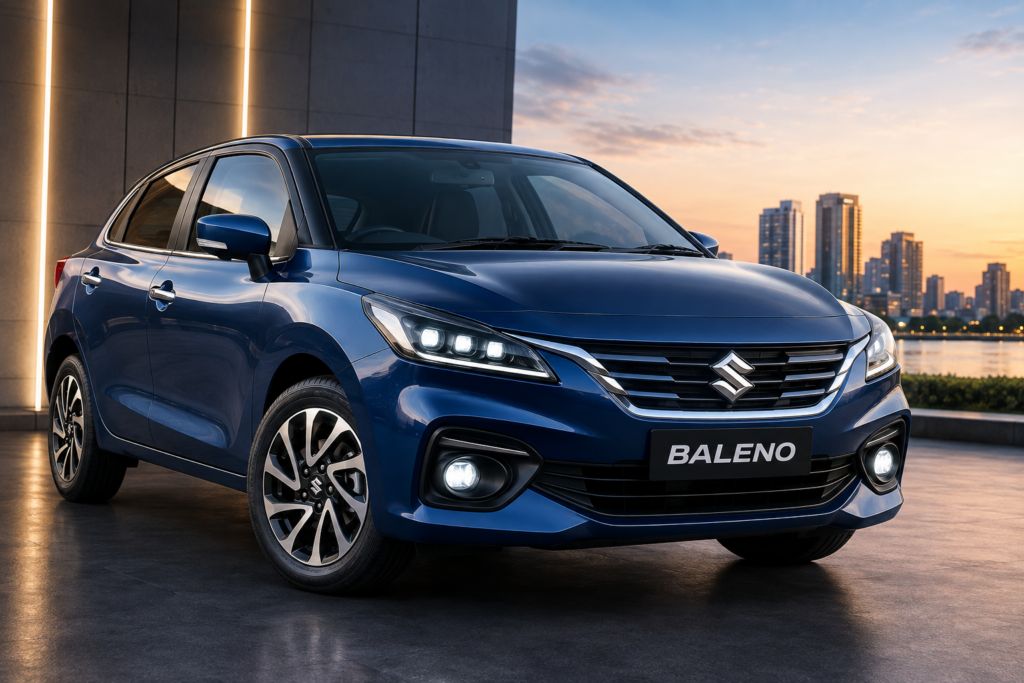
The facelifted Baleno gets its most noticeable visual changes at the front.
The premium hatchback now features a larger front grille with pronounced horizontal slats, giving the car a wider and more aggressive appearance. The bumper has also been redesigned, adding sharper detailing to the front profile.
Maruti Suzuki has retained the Baleno’s signature Nexa three-dot LED headlamp design, which has become one of the recognizable styling elements of the premium hatchback. However, the facelift gets updated LED fog lamps that give the lower section of the front bumper a fresher appearance.
The changes aren’t intended to completely transform the Baleno’s design. Instead, Maruti has followed an evolutionary approach, retaining the basic shape and proportions that have helped make the hatchback popular.
From the side, the Baleno continues with its familiar flowing roofline and large glass area. The facelift retains 16-inch alloy wheels, while a new shark-fin antenna adds a small but noticeable upgrade to the profile.
Another new exterior detail is the chrome garnish positioned behind the bonnet line, which gives the front section a slightly more premium appearance.
Rear Design Remains Largely Unchanged
Compared with the front, the rear of the 2026 Baleno facelift receives very few changes.
The familiar L-shaped LED tail lamps continue to be part of the design, while the high luggage loading lip is also retained.
This means the facelift will still be immediately recognizable as a Baleno from the rear.
The decision to keep the rear design largely unchanged also suggests that Maruti has focused its development efforts on areas that matter more to buyers, particularly technology, safety and the powertrain.
Level 2 ADAS Comes to the Baleno
One of the most significant upgrades to the new Baleno is its advanced driver assistance technology.
The facelift introduces Level 2 ADAS, supported by a combination of a radar module and a front-facing camera positioned around the front grille.
This technology allows the car to assist the driver in several situations rather than simply providing passive safety features.
Depending on the system configuration, Level 2 ADAS can combine functions such as adaptive cruise control, lane assistance and autonomous emergency braking to reduce driver workload and improve safety.
For the Baleno, this is an important upgrade because advanced driver assistance technology has traditionally been more common on larger and more expensive vehicles.
Maruti Suzuki has been expanding its ADAS technology across its newer models, and the Baleno’s addition of the system represents another step towards bringing these features into more accessible segments.
More Premium Cabin Features
The basic dashboard design of the Baleno remains familiar. The car continues to use its existing layout with analog instrument dials and the pop-out Head-Up Display.
However, Maruti has added several new features to make the cabin more premium and comfortable.
One of the most notable additions is ventilated front seats. This feature should be particularly useful in India’s hot weather, allowing the front occupants to experience improved comfort during longer journeys.
The facelift also gets a wireless charging pad, reducing the need for charging cables when using compatible smartphones.
Another practical addition is a Tyre Pressure Monitoring System (TPMS). Instead of requiring the driver to manually check tyre pressures, information can be displayed directly through the car’s touchscreen system.
The sound system has also been upgraded, with a Clarion audio system expected to improve the in-cabin audio experience.
The seats now receive part-leatherette upholstery, further improving the premium feel of the cabin.
Together, these upgrades make the facelifted Baleno feel more sophisticated without completely changing the interior architecture.
The Biggest Change Is Under the Bonnet
While the exterior and interior updates are important, the biggest change to the 2026 Baleno comes from its engine.
Maruti Suzuki has replaced the outgoing 1.2-litre K12 four-cylinder petrol engine with the newer Z12 1.2-litre three-cylinder petrol engine.
The Z-Series engine first appeared in the Swift, but the Baleno receives a different state of tune.
On paper, the transition results in a reduction in peak power. The outgoing engine produced around 90hp, while the new motor produces approximately 82hp.
However, Maruti Suzuki is not positioning the new engine around peak horsepower alone.
The company claims that the new engine provides improved torque delivery and better low-end tractability. This could make the Baleno easier to drive in city traffic, where strong response at lower engine speeds can be more useful than outright peak power.
The new engine also places a greater emphasis on fuel efficiency.
High-Compression Z-Series Engine
Another interesting aspect of the new engine is its compression ratio and fuel calibration.
Unlike the version used in the Swift, the Baleno’s Z12 engine is tuned with a higher compression ratio, with the calibration optimized around 95-octane fuel.
This approach is linked to the transition towards E20-compatible fuel, which is becoming increasingly important in the Indian automotive market.
The focus is therefore not simply on extracting maximum power from the engine. Maruti is attempting to balance efficiency, emissions and everyday drivability.
For customers, the real-world difference will likely be felt more in fuel economy and low-speed response than in outright acceleration figures.
Manual and AMT Options
The new Z12 engine continues to be paired with two transmission options.
Buyers can choose a 5-speed manual gearbox, while those looking for an automatic option get an AMT, or Automated Manual Transmission.
The manual should appeal to buyers who prefer greater control over the car, while the AMT is likely to remain the more convenient choice for city driving.
The availability of an automatic option is particularly important in the premium hatchback segment, where urban buyers increasingly prefer two-pedal cars for daily commuting.
Baleno Remains One of the Roomiest Hatchbacks
Despite the mechanical changes, the Baleno retains one of its strongest advantages — its spacious cabin.
The hatchback continues to offer generous legroom and knee room, making it one of the more accommodating cars in its segment.
Rear passengers should have enough space even when taller occupants are seated in the front.
However, rear headroom remains more average. The sloping roofline and overall design mean that taller passengers may find headroom adequate rather than exceptionally generous.
For families, though, the combination of a relatively compact exterior with a spacious cabin remains one of the Baleno’s biggest strengths.
Technology and Practicality Remain Key Selling Points
The Baleno has traditionally competed by offering a combination of space, features, efficiency and Maruti Suzuki’s extensive sales and service network.
The facelift strengthens this formula.
Features such as the Head-Up Display, wireless charging, upgraded audio system and TPMS improve convenience, while ventilated seats add an extra layer of comfort.
The introduction of Level 2 ADAS also gives the car a much stronger technology proposition.
At the same time, Maruti has avoided making the cabin unnecessarily complicated. The familiar dashboard layout and existing controls should make the car relatively easy for existing Baleno customers to adapt to.
What Does the New Engine Mean for Buyers?
The switch from a four-cylinder engine to a three-cylinder unit is likely to be one of the most discussed aspects of the facelift.
A three-cylinder engine can naturally have a different refinement character compared with a four-cylinder motor. The reduction in peak power may also raise questions among buyers who enjoyed the outgoing engine’s performance.
However, Maruti’s focus with the Z12 is clearly on efficiency and usable low-end torque rather than outright performance.
For someone primarily using the Baleno for city commuting, fuel economy and easy drivability could be more important than a small difference in peak horsepower.
The AMT option should further strengthen the car’s urban appeal.
Price and Competition
The 2026 Maruti Suzuki Baleno facelift starts at ₹6.1 lakh, putting it in a highly competitive part of the Indian passenger-car market.
The key competition comes from the Hyundai i20, Tata Altroz and Toyota Glanza.
The Baleno’s biggest advantages continue to be its spacious interior, premium-hatchback positioning and Maruti Suzuki’s extensive ownership ecosystem.
The facelift now adds several features that could make the competition even more interesting, particularly Level 2 ADAS and ventilated seats.
Is the Baleno Facelift a Major Update?
The answer is yes, although the changes aren’t equally significant in every area.
Visually, the facelift is an evolutionary update. The front end gets a redesigned grille and bumper, while the side and rear profiles remain largely familiar.
Inside, however, the car receives several meaningful additions, including ventilated seats, wireless charging, TPMS integration, upgraded audio equipment and part-leatherette upholstery.
The biggest transformation is under the bonnet, where the old four-cylinder petrol engine has been replaced by the new 1.2-litre Z12 three-cylinder unit.
The introduction of Level 2 ADAS is arguably the most significant technology upgrade and could become one of the major reasons for buyers to choose the facelift over the outgoing version.
Final Verdict
The 2026 Maruti Suzuki Baleno facelift is a comprehensive update aimed at keeping one of India’s most popular premium hatchbacks competitive in a rapidly changing market.
The new exterior styling gives the Baleno a fresher face without abandoning its familiar design, while the cabin gains useful comfort and technology upgrades.
But the biggest story is the combination of Level 2 ADAS and the new Z-Series engine.
The engine sacrifices some peak power compared with the outgoing four-cylinder motor, but Maruti is targeting stronger low-end tractability and improved fuel efficiency. Meanwhile, the new safety technology brings advanced driver assistance features into a more affordable segment.
With a starting price of ₹6.1 lakh, the facelifted Baleno has the potential to remain a strong choice for buyers who want a spacious, feature-rich premium hatchback with modern safety technology and an efficient petrol powertrain.
For Maruti Suzuki, the update also represents an important step towards bringing newer engine technology and advanced driver assistance systems to a wider range of Indian buyers.