India’s electric vehicle market is entering a major phase of growth, with manufacturers introducing new EVs across multiple price segments while governments and private companies continue to expand charging infrastructure.
At the same time, the way customers buy electric cars is also changing. Battery-as-a-Service (BaaS) is becoming an increasingly important part of the EV ownership equation, allowing buyers to reduce the upfront cost of an electric vehicle by paying separately for battery usage.
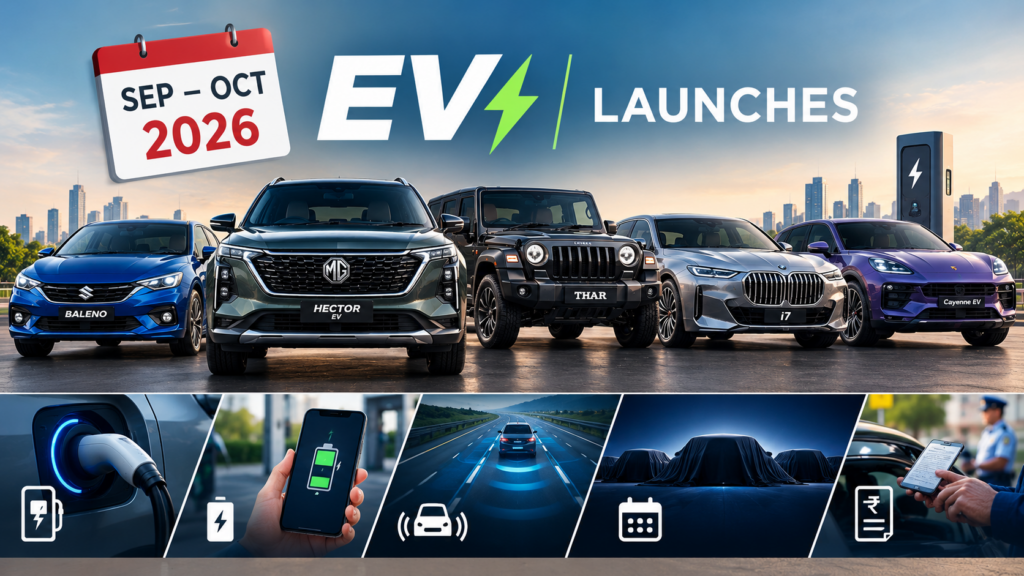
The latest developments include the launch of the new MG Hector Tomahawk, Mahindra’s expansion of its BaaS programme, new charging infrastructure across several states, upcoming EVs from Mahindra, Hyundai, BYD and Tata, and several challenges related to EV servicing and insurance.
Here’s everything you need to know about the latest developments in India’s EV market.
MG Hector Tomahawk Brings EV and PHEV Options
One of the biggest recent launches is the MG Hector Tomahawk, introduced by JSW MG Motor India as a premium SUV available with both electric and plug-in hybrid powertrains.
The Hector Tomahawk EV is offered in five- and seven-seat configurations, giving buyers the option of prioritising either passenger space or additional boot capacity.
The EV uses a 69.2kWh battery pack and has an official claimed MIDC range of 517km on a full charge. It produces 204PS and 310Nm and comes with features such as Level 2 ADAS, a 15.6-inch touchscreen, a 360-degree camera and Vehicle-to-Home capability.
The EV’s introductory ex-showroom price starts at around ₹19.49 lakh, while the BaaS version brings the initial price down to ₹13.99 lakh, with a separate battery rental charge of ₹4.90 per km.
The Hector Tomahawk is also available as a plug-in hybrid, giving MG a product that can appeal to customers who want electric driving but still require the flexibility of an internal-combustion engine for longer journeys.
The PHEV claims a combined driving range of more than 1,100km with a full tank and full battery charge.
Battery-as-a-Service Could Change EV Ownership
Perhaps one of the biggest developments in the current EV market is the growing popularity of the Battery-as-a-Service model.
The battery is one of the most expensive components of an electric vehicle. By separating the cost of the battery from the vehicle itself, manufacturers can advertise a much lower upfront price.
MG’s Hector Tomahawk EV is one of the clearest examples of this approach. Instead of paying the full vehicle price from the beginning, customers can purchase the vehicle at a lower upfront cost and then pay a fixed amount for every kilometre driven.
For the Hector Tomahawk EV, the introductory BaaS price starts at ₹13.99 lakh plus ₹4.90 per km for battery usage.
This could make electric SUVs more accessible to buyers who are comfortable with the ongoing battery rental cost.
However, customers will need to calculate their expected annual driving distance before choosing between outright battery ownership and BaaS. A buyer who drives very high annual kilometres could eventually pay a substantial amount through the per-kilometre model.
Mahindra Expands BaaS Across Its EV Range
MG isn’t the only manufacturer moving towards this ownership model.
Mahindra has also expanded its Battery-as-a-Service offering across its electric vehicle portfolio, including models such as the BE 6, XUV 9e and XUV 9S.
The objective is straightforward: reduce the upfront purchase price and make Mahindra’s electric SUVs more accessible to a larger group of customers.
BaaS could become an important part of India’s EV market as manufacturers compete not only on range and features but also on the initial price customers see when they walk into a showroom.
The model also changes how customers think about EV ownership. Instead of treating the battery as an asset purchased together with the vehicle, buyers effectively pay for battery usage over time.
Tata Motors Raises Prices After Heavy Discounts
While EV manufacturers are trying to make electric cars more affordable through new ownership models, Tata Motors has taken a different step on pricing.
Tata Motors offered discounts of up to ₹3 lakh on selected vehicles in August as competition increased from manufacturers such as Hyundai, Mahindra and BYD.
However, from September 1, Tata Motors implemented a price increase of up to ₹25,000 across its passenger vehicle range.
The price increase comes at a time when manufacturers are facing higher input and operating costs.
For EV buyers, Tata’s pricing strategy will be particularly important because the company remains one of India’s biggest electric-car manufacturers.
BYD Adds a New Seal Variant
Chinese EV manufacturer BYD continues to expand its presence in India.
The company has introduced the Seal Dynamic variant, positioned as a more accessible version of its premium electric sedan. The variant is priced around ₹41.90 lakh.
BYD is also expected to consider bringing its smaller Atto 2 to India.
If launched in the expected ₹20 lakh to ₹30 lakh price range, the Atto 2 could become an important competitor to upcoming electric SUVs from Mahindra, MG and other manufacturers.
BYD’s advantage comes from its global EV experience, battery technology and premium cabin positioning.
A competitively priced Atto 2 could therefore give Indian EV buyers another option between mainstream electric SUVs and more expensive premium EVs.
India’s EV Charging Network Is Expanding
Range anxiety remains one of the biggest concerns among potential EV buyers.
However, India’s public charging infrastructure is expanding rapidly, with both governments and private companies investing in new charging points.
One of the interesting aspects of EV charging infrastructure is that chargers can be installed at a much wider variety of locations compared with traditional petrol pumps.
Instead of requiring a dedicated fuel station, EV chargers can be installed at hospitals, hotels, airports, bus stands, shopping areas and public parking spaces.
Karnataka Plans 1,250 Chargers
Under the PM E-Drive scheme, Karnataka is planning to deploy around 1,250 charging stations.
The chargers are expected to be installed not only along highways but also at important public locations such as hospitals, hotels, airports and bus stands.
This approach could make EV charging more convenient for people who do not necessarily travel long distances.
Rajasthan Announces ₹100 Crore Charging Investment
Rajasthan is also preparing a major charging infrastructure expansion.
The state government has planned an investment of around ₹100 crore for setting up 236 EV chargers across six major cities.
Increasing charger availability in urban areas could help encourage EV adoption among people who primarily use their vehicles for daily city commuting.
Uttar Pradesh Targets 10,000 Chargers
Uttar Pradesh already has around 2,500 active chargers, according to the figures discussed in the video.
The state has a much larger long-term target of approximately 10,000 charging stations.
Given the size of Uttar Pradesh and the increasing number of EVs on its roads, building a reliable charging network will be important for reducing concerns around long-distance travel and everyday charging access.
Delhi Moves Towards a New EV Policy
Delhi is also continuing its push towards electric mobility under EV Policy 2.0.
The capital recorded around 1,079 EV sales in July, while the new policy framework focuses increasingly on cleaner public mobility and alternative incentives.
Instead of relying solely on direct purchase subsidies, the policy approach includes measures such as vehicle scrappage benefits and support for cleaner transportation.
Delhi remains one of India’s most important markets for EV adoption because of its large urban population and the government’s focus on reducing vehicle emissions.
EV Ownership Still Has Major After-Sales Challenges
Despite the rapid growth of EV sales, ownership isn’t without problems.
One of the biggest concerns emerging in the market is after-sales support.
Reports of technical and electronic problems involving premium EVs have highlighted the challenges that manufacturers, dealerships and insurance companies still need to address.
Some EV owners have reported issues involving infotainment systems, electronics and under-body battery damage. In such situations, customers can face delays while waiting for specialised diagnosis, repairs or insurance approvals.
This becomes particularly important because EVs require a different technical skill set compared with conventional petrol and diesel vehicles.
Why Local EV Repair Support Is Still Limited
A conventional mechanic who is comfortable working on engines, transmissions and exhaust systems cannot simply start repairing an EV.
Electric vehicles use high-voltage battery systems, electric motors, power electronics and sophisticated software.
As a result, general mechanics often cannot safely work on EV-specific components.
Even authorised dealerships usually maintain specialised EV teams rather than allowing conventional petrol and diesel technicians to handle high-voltage systems.
This means EV buyers should pay close attention to the manufacturer’s service network and the availability of trained technicians before purchasing an electric car.
As EV adoption increases, independent workshops will eventually need to develop the skills and equipment required to safely service these vehicles.
Five Upcoming EVs to Watch in India
The next wave of electric vehicles could make the Indian EV market even more competitive.
Mahindra Thar EV
The Mahindra Thar EV is one of the most anticipated upcoming electric SUVs.
Expected around late 2026, it is likely to combine the rugged design language of the Thar with Mahindra’s electric vehicle technology.
If priced appropriately, it could become one of the most distinctive electric SUVs in the market.
Hyundai Compact EV
Hyundai is also expected to introduce a new compact electric SUV around late 2026 or early 2027.
The model is expected to occupy the space between smaller EVs and larger electric SUVs, giving Hyundai a product capable of competing with models such as the Tata Punch EV and Nexon EV.
BYD Atto 2
The BYD Atto 2 could be one of the most interesting new entrants if it comes to India.
A potential price positioning of around ₹20 lakh to ₹30 lakh would place it directly in one of the fastest-growing EV segments.
BYD’s technology and premium positioning could make the Atto 2 a serious competitor to Indian electric SUVs.
Mahindra Vision S
The Mahindra Vision S is another upcoming electric SUV based on the company’s advanced INGLO architecture.
It is expected to be a five-seater compact SUV with an emphasis on driving dynamics, technology and battery range.
Tata Safari EV
The Tata Safari EV could fill one of the biggest gaps in Tata Motors’ current electric portfolio.
A seven-seat electric SUV would give Tata a direct product to compete with larger upcoming electric SUVs, including Mahindra’s XUV 9S.
For families looking for a large electric SUV, the Safari EV could become one of Tata’s most important upcoming launches.
New Traffic Fines You Should Know
The latest traffic-fine figures discussed in the video also serve as an important reminder for motorists.
The penalties highlighted include:
| Traffic Violation | Fine |
|---|---|
| Drunk driving | ₹10,000 |
| Driving without a licence | ₹5,000 |
| No number plate | ₹5,000 |
| No vehicle insurance | ₹2,000 |
| No helmet / triple riding | ₹1,000 |
| Wrong-side driving / red-light jumping | ₹1,000 |
| Over-speeding | ₹1,000 |
| Using a mobile phone while driving | ₹1,000 |
| Modified/loud silencer | ₹1,000 |
| No seat belt | ₹1,000 |
| No PUC certificate | ₹1,000 |
| Wrong parking | ₹500 |
| Black window film | ₹1,000 |
The exact penalty can vary by offence, vehicle category and jurisdiction, so motorists should check the applicable state rules rather than assuming that every fine is identical across India. The ₹10,000 drunk-driving and ₹1,000 seat-belt/helmet penalties, for example, are reflected in the Motor Vehicles Act’s revised penalty framework.
India’s EV Market Is Moving Into a New Phase
India’s EV market is no longer limited to a handful of small electric cars.
Manufacturers are now launching large SUVs, premium EVs, plug-in hybrids and technology-heavy electric vehicles, while ownership models such as BaaS are changing the way customers pay for their cars.
The launch of the MG Hector Tomahawk is a good example of this transition. It combines a large SUV body, a sizeable battery, advanced driver assistance, connected technology and multiple powertrain choices while offering customers the option of reducing the upfront cost through BaaS.
At the same time, the expansion of charging infrastructure across Karnataka, Rajasthan, Uttar Pradesh and Delhi should gradually make EV ownership more practical.
However, the industry still has work to do. Better after-sales support, trained technicians, transparent insurance processes and reliable charging availability will be just as important as battery range and vehicle features.
With the Mahindra Thar EV, Hyundai’s upcoming compact EV, BYD Atto 2, Mahindra Vision S and Tata Safari EV on the horizon, India’s electric-car market is set to become even more competitive.
For buyers, that could ultimately mean more choices, better technology and greater pressure on manufacturers to deliver not just attractive EVs, but a complete ownership experience.