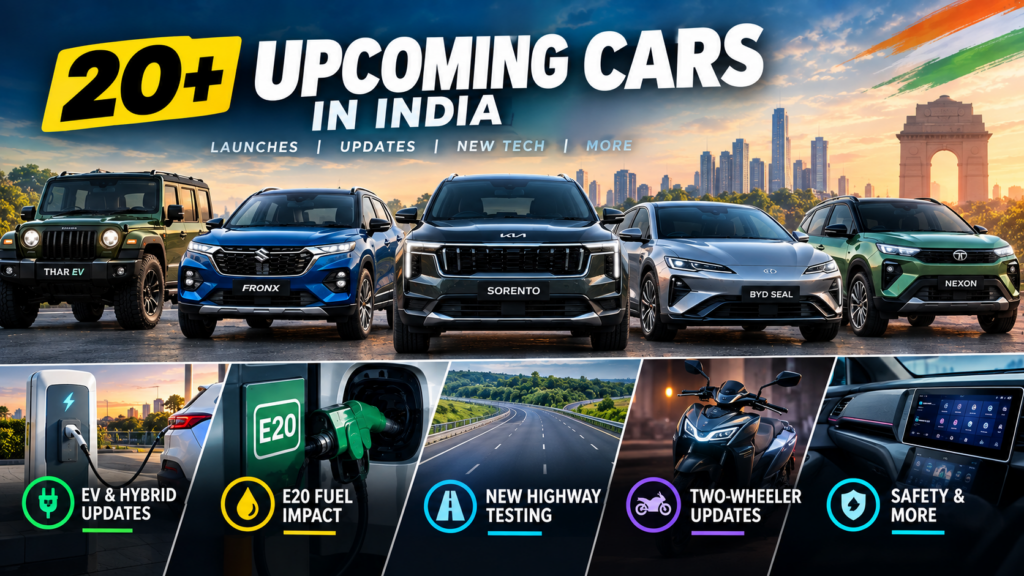
The Indian automobile industry is entering an extremely busy phase, with manufacturers preparing new launches, facelifts, electric vehicles and technology upgrades across almost every segment. From Maruti Suzuki’s global export milestone and the new Baleno facelift to Kia’s expanding hybrid portfolio, BMW’s updated flagship sedans and growing concerns around E20 fuel, the latest developments highlight how quickly the Indian car market is changing.
Here are the biggest automotive developments currently making headlines.
Maruti Suzuki Fronx Crosses 2 Lakh Export Milestone
Maruti Suzuki has achieved a major international milestone with the Fronx. The compact SUV has crossed 2 lakh export units, reaching more than 90 countries in just 38 months.
The Fronx has become one of Maruti Suzuki’s important global products, particularly in markets where compact SUVs and crossovers are seeing strong demand. The milestone also highlights Maruti’s growing focus on exporting India-made vehicles to international markets.
Meanwhile, the company has introduced a major update to another popular premium product. The 2026 Maruti Suzuki Baleno facelift was launched earlier this month with a starting price of around ₹6.10 lakh.
The facelift brings a new 1.2-litre three-cylinder Z12E petrol engine, Level 2 ADAS and additional comfort features. The new engine produces 83hp and 112Nm and is available with a 5-speed manual and AMT.
Hyundai Raises Prices Again as New EV Plans Take Shape
Hyundai has discontinued the Tucson from the Indian market after relatively weak sales, even though the next-generation Tucson has already been revealed globally.
The company is also implementing another price increase in India. The latest hike comes after multiple price revisions during 2026, highlighting the continued pressure from rising input and operating costs.
At the same time, Hyundai is preparing for the next phase of its electric vehicle strategy. The company has announced plans for a sub-4-metre electric vehicle, which is expected to target the mass-market EV segment and could arrive around March 2027.
A compact EV from Hyundai could become an important rival to models such as the Tata Punch EV and other upcoming small electric SUVs.
Kia Expands Its Hybrid and Electric Vehicle Strategy
Kia continues to rapidly expand its product portfolio in India.
One of the biggest developments is the Kia Sorento, which has now officially entered the Indian market. The three-row SUV was launched at a starting price of ₹27.99 lakh, becoming Kia India’s new flagship ICE SUV.
The Sorento is offered with strong-hybrid and diesel powertrains, with the hybrid version also getting an all-wheel-drive configuration. Kia had positioned the model as a major rival to SUVs such as the Toyota Fortuner and other premium three-row SUVs.
Kia is also preparing hybrid technology for models such as the Sonet and Carens/Clavis, with the technology expected to become part of the company’s portfolio by 2029.
Another important development is Kia’s plan for a sub-4-metre electric vehicle. The upcoming model could directly challenge the Tata Punch EV and help Kia establish itself in India’s growing affordable EV market.
Volkswagen and Skoda Prepare New Compact SUV and CNG Plans
Volkswagen is working on a new sub-4-metre SUV for India, expected around 2027. The compact SUV is likely to use the company’s familiar 1.0-litre TSI turbo-petrol engine and could share technology with other products from the Volkswagen-Skoda group.
The company could also benefit from potential changes in import duties between India and Europe, which may make it easier for Volkswagen and Skoda to bring selected imported models to the country.
Skoda, meanwhile, is evaluating factory-fitted CNG technology for its 1.0-litre TSI-powered models. If approved, this could eventually provide a CNG alternative for cars such as the Slavia and Kushaq.
Skoda has also revealed the updated Slavia facelift, which brings changes including an 8-speed automatic transmission and rear-seat comfort upgrades.
The Volkswagen-Skoda ecosystem is also expected to undergo further changes through its partnership with JSW, which is set to play an increasingly important role in the group’s Indian operations.
BMW 7 Series and i7 Facelifts Coming With Major Technology Upgrades
BMW is preparing to introduce the facelifted 7 Series and i7 in India on September 11.
The updated flagship sedans feature revised exterior styling, including an illuminated kidney grille and redesigned split LED headlamps. However, the biggest changes are inside the cabin.
The new models receive BMW’s latest Panoramic iDrive setup, a 17.9-inch central touchscreen and a 14.6-inch passenger display. Rear passengers continue to get a luxury-focused cabin with powered seats featuring heating, ventilation and massage functions.
One of the biggest highlights is the 31.3-inch 8K Theatre Screen, which turns the rear cabin into a high-end entertainment lounge.
BMW has also updated the powertrain options internationally, although the exact India-spec lineup will be confirmed around the launch.
The company has additionally introduced the BMW X1 Long Wheelbase in India at around ₹50 lakh, with a petrol powertrain.
Audi Q3 and Volvo Electric SUVs Add More Premium Competition
Audi is preparing the next-generation Q3 for India. The new-generation SUV brings a redesigned exterior and a substantially updated cabin, and it is expected to sit around the ₹60 lakh price range depending on the final variant lineup.
Volvo is also expanding its electric portfolio with the upcoming EX90 and ES90. The two models are scheduled for their Indian launch in October, with the company targeting the premium electric SUV and sedan segments.
The EX90 and ES90 are expected to offer long driving ranges, with estimates in the region of 600–700km, depending on the variant and testing cycle.
Mahindra Expands XEV 9e Lineup
Mahindra has added a new six-seat version of the XEV 9e, priced at ₹25.5 lakh.
The new seating configuration gives customers another option in the electric SUV segment and strengthens Mahindra’s growing EV portfolio.
The company is also preparing several other electric products, including future SUV models designed around its INGLO-based electric architecture.
MG Hector Tomahawk EV and BYD Seal Dynamic
MG continues to expand its EV lineup with the Hector Tomahawk EV, which was launched in August alongside a plug-in hybrid version.
The new electric SUV is part of MG’s strategy to offer more premium electrified vehicles while continuing to expand its battery and subscription-based ownership options.
BYD has also updated its Seal lineup with a new Dynamic trim. The new variant is positioned below the Premium version and makes the electric sedan significantly more affordable, reportedly by around ₹8 lakh compared with the higher trim.
The move gives BYD a stronger position in India’s premium electric sedan market.
Honda Elevate Facelift Spotted With New Features
Honda’s updated Elevate has been spotted testing in Japan, giving an early look at the company’s upcoming facelift.
The updated SUV is expected to receive additional comfort and technology features, including ventilated seats and a 360-degree camera.
Honda is also expected to make changes to the exterior and interior as it attempts to keep the Elevate competitive against newer SUVs in the segment.
Genesis GV9 EV and VinFast VF5 Spotted in India
Hyundai’s luxury brand Genesis has revealed the GV9 EV, a large electric SUV equipped with a 123.5kWh battery.
The model is positioned as a flagship luxury EV and features advanced safety and comfort technology, including a roof-mounted airbag system.
Meanwhile, VinFast has been spotted testing its VF5 electric SUV in Bengaluru. The compact EV could eventually become part of VinFast’s India strategy as the Vietnamese manufacturer expands its local presence.
E20 Fuel Concerns Continue to Affect Buyers
One of the biggest discussions in the Indian automotive market currently revolves around E20 petrol.
Concerns over compatibility with older petrol vehicles have reportedly affected used-car demand in some markets, particularly where buyers are worried about long-term fuel-system durability and mileage.
The issue has also contributed to growing interest in higher-octane petrol. Demand for fuels such as XP95 has reportedly increased sharply as some owners look for alternatives for vehicles that may not have been designed around higher ethanol blends.
The discussion has become significant enough for industry stakeholders to call for greater availability of E10 fuel alongside E20, particularly for older vehicles.
Recent industry data shows that alternative-fuel passenger vehicles—including CNG, hybrids and EVs—actually surpassed petrol-powered passenger vehicles in India’s August 2026 retail mix, accounting for nearly 42% compared with around 41% for petrol. FADA attributed part of the shift to E20 concerns, fuel costs and the growing availability of alternative powertrains.
China Recalls 4.3 Million Vehicles Over Door Handle Safety
China has also introduced a major safety-related development by ordering a recall involving approximately 4.3 million vehicles.
The move follows safety concerns surrounding flush door handles, particularly their operation during emergencies and crashes.
The development could influence future vehicle safety regulations and design approaches globally as manufacturers increasingly adopt electronically operated door handles.
India Considers Testing Period for New Highways
The Indian government is also considering a two-to-three-month testing period for newly constructed highways before they are opened for regular public use.
The idea is aimed at identifying potential problems with road design, safety infrastructure and construction quality before a highway becomes fully operational.
Such a testing phase could help reduce safety risks and allow authorities to address defects before large volumes of traffic begin using new roads.
Two-Wheeler Market Also Gets Several Updates
The two-wheeler industry is also preparing for multiple new products and updates.
Simple Energy is preparing to launch its Wave family of electric scooters, while Bajaj is working on updated versions of the Pulsar 125 and Pulsar 150.
Royal Enfield has expanded its Classic lineup with the Goan Classic/Gorakha edition, priced at around ₹2.1 lakh.
Yamaha has also updated the R15, with a new TFT display and additional colour options to keep the motorcycle competitive in India’s performance-bike market.
India’s Auto Market Is Moving Rapidly Towards Electrification
The latest developments show that India’s automotive industry is undergoing a major transition.
Traditional petrol and diesel vehicles continue to dominate several segments, but manufacturers are increasingly investing in EVs, hybrids, CNG and alternative powertrain technologies. At the same time, consumers are becoming more conscious of fuel compatibility, running costs and long-term ownership.
From compact EVs and hybrid SUVs to luxury electric vehicles and updated internal-combustion models, the coming months are expected to remain extremely busy for the Indian automobile market.