
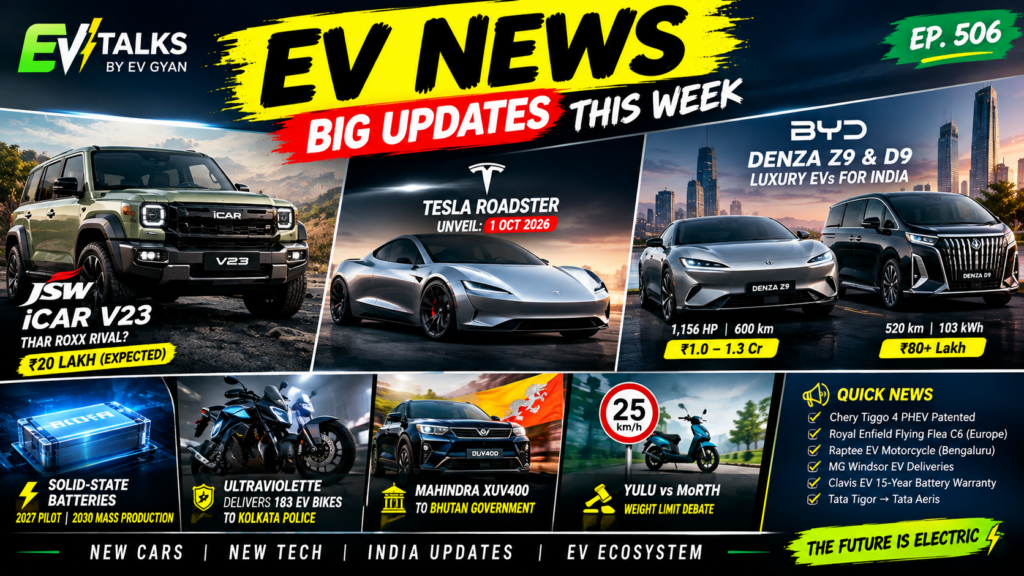
The Indian electric vehicle market is heading into another important phase, with several new models, battery technologies and regulatory developments expected to shape the industry over the coming years. From JSW’s upcoming electric SUV based on the Chery iCaur V23 to BYD’s premium Denza models and Tesla’s long-awaited Roadster, the latest developments cover everything from affordable electric mobility to high-performance EVs.
The latest updates also include new electric motorcycle fleet orders, changes being discussed for low-speed electric two-wheelers and new battery technology that could eventually improve the range and charging capabilities of future EVs.
JSW iCar V23-Based Electric SUV Patented for India
JSW Motors is preparing another major addition to its upcoming electric vehicle portfolio with an India-spec version of the Chery iCaur V23. The design of the SUV has now been patented in India, revealing several changes compared with the international model. (autocarindia.com)
The boxy electric SUV is expected to target buyers looking for a more rugged alternative to conventional electric SUVs. Its design and proportions could also allow it to compete for attention with lifestyle SUVs such as the Mahindra Thar Roxx.
The India-spec version is expected to receive changes to the alloy wheels and exterior detailing, while the patent filing also points towards features such as a panoramic sunroof. An AWD version is also expected to be offered. (autocarindia.com)
The specifications discussed for the model include a roughly 60kWh battery for the standard rear-wheel-drive version, producing around 134 hp and 180 Nm. A more powerful AWD version could use an 81kWh battery, with around 208 hp and 292 Nm and a claimed range of approximately 430km under the relevant test cycle.
The expected price could be around ₹20 lakh, although JSW Motors has not yet announced final pricing.
MG Windsor Driverless Creep Incident Explained
The MG Windsor EV recently became the subject of viral videos showing the electric car moving even though nobody appeared to be sitting in the driver’s seat.
The incident has been linked to the way the vehicle’s safety systems interpreted the driver’s seatbelt status. In the situation described, the seatbelt was reportedly buckled behind the driver’s back before the person exited the vehicle.
With the belt still connected and the door subsequently closed, the car could interpret the situation as though the driver remained seated. Since an automatic vehicle can move slowly in creep mode when the brake is released, the Windsor began moving forward.
The incident therefore highlights the importance of correctly using the vehicle’s safety systems rather than indicating an EV powertrain malfunction.
BYD Denza Z9 GT and D9 Coming to India
BYD is preparing to expand into India’s premium luxury EV market through its Denza brand. The company is expected to bring two models to India: the Denza Z9 GT and the Denza D9.
Recent reports indicate that both models could arrive in India by the end of 2026 as completely built units, with Denza positioned above BYD’s existing portfolio. (autocarindia.com)
Denza Z9 GT
The Denza Z9 GT is the performance-focused model and could become one of the most powerful electric vehicles available in India.
The global-specification model uses a triple-motor setup producing up to 1,156 hp and 1,210 Nm. It can accelerate from 0–100 km/h in around 2.7 seconds, while the battery capacity is approximately 122kWh.
The model is claimed to offer around 600km of WLTP range. Its ultra-fast charging capability is another major highlight, although charging at the maximum claimed rate would require infrastructure that is not currently widely available in India.
The Z9 GT is expected to be positioned at around the ₹1 crore-plus level in India. Autocar India currently expects the model to arrive by the end of 2026 with an estimated price range of around ₹1.10–1.50 crore. (autocarindia.com)
Denza D9
The Denza D9 will take a completely different approach. Instead of outright performance, it focuses on luxury and executive comfort.
The electric MPV features a spacious cabin with premium captain seats and is expected to compete with models such as the MG M9 and Toyota Vellfire.
The global-spec D9 uses a 103kWh battery and offers a claimed range of up to around 520km WLTP in its front-wheel-drive version. (autocarindia.com)
BYD is expected to position the D9 around the ₹80 lakh to ₹1 crore price bracket. The first Denza launch could take place around Diwali 2026, although a February 2027 debut remains possible if the schedule is delayed. (autocarindia.com)
Tesla Roadster Set for October 1 Unveil
After years of delays, the second-generation Tesla Roadster finally has an official unveil date.
Tesla has announced that the production-spec Roadster will be unveiled on October 1, 2026, nearly nine years after the original concept was first shown in 2017. Tesla’s latest teaser also includes the phrase “Go for launch” and appears to show four nozzles at the rear of the car. (reuters.com)
The new Roadster is expected to be positioned as an ultra-high-performance electric sports car. Earlier Tesla claims for the Roadster included a sub-two-second 0–100 km/h acceleration time, a very high top speed and a range of more than 600 miles.
The biggest talking point, however, is the proposed SpaceX package. Tesla has previously discussed using cold-gas thrusters developed with SpaceX to improve acceleration and vehicle dynamics.
The latest teaser appears to reference those thrusters, although the final production specifications and the exact functionality of the system will only become clear at the October 1 reveal. (techcrunch.com)
BYD Working Towards Solid-State Batteries
Battery technology could see another major development in the coming years, with BYD working on solid-state battery technology.
According to the plans highlighted in the latest industry discussions, BYD intends to begin deploying solid-state batteries in small pilot fleets from 2027, with more than 1,000 test vehicles potentially being used for real-world development.
The technology uses an inorganic sulfide-based solid electrolyte and is targeting energy density of around 400Wh/kg. This would represent a significant increase compared with conventional lithium-iron-phosphate battery technology.
However, the technology is still at the development and validation stage. Large-scale commercial production is expected only later, with around 2030 being discussed as a potential timeframe for wider adoption.
If successful, solid-state batteries could eventually offer higher energy density while improving the packaging and range potential of future electric vehicles.
Ultraviolette and Mahindra Achieve Important EV Milestones
India’s electric mobility sector is also seeing growth in fleet adoption.
Ultraviolette Automotive has delivered 183 X47 Skyf electric motorcycles to the Kolkata Police, representing a significant single fleet order for an Indian electric motorcycle manufacturer.
The X47 Skyf is positioned as a premium electric motorcycle and brings a combination of performance-focused engineering and connected technology to the segment.
Meanwhile, 54 Mahindra XUV400 electric SUVs were handed over to Bhutan for official government fleet use. The move adds another international fleet deployment for an India-made electric SUV.
Yulu Raises Concerns Over Slow-Speed EV Weight Rules
Another important development involves India’s regulatory framework for low-speed electric two-wheelers.
The Ministry of Road Transport and Highways has proposed changes concerning the 60kg unladen-weight limit currently associated with slow-speed electric two-wheelers. These vehicles can operate at speeds of up to 25km/h and use motors below the applicable power threshold.
Yulu has raised concerns over removing the weight restriction. The company argues that allowing significantly heavier vehicles to remain within the slow-speed category could create safety concerns if such vehicles continue to operate without the same licensing, helmet and registration requirements applied to higher-speed vehicles.
The debate highlights the challenge regulators face in balancing accessibility for low-speed electric mobility with road-safety requirements.
More EV Updates From India
Several other developments are also gaining attention across India’s EV industry.
The Chery Tiggo 4 PHEV has been patented in India, adding another Chery product to the growing list of models associated with the company’s partnership with JSW. Recent reports also mention patents for other Chery-related products in India. (navbharattimes.indiatimes.com)
The Royal Enfield Flying Flea C6 has also expanded into European and UK markets, bringing Royal Enfield’s electric motorcycle technology to international customers.
Meanwhile, Raptee has started deliveries of its electric motorcycle in Bengaluru, while MG Windsor EV customer deliveries continue to expand across India.
The Kia Clavis EV has also introduced an extended battery warranty of up to 15 years with unlimited kilometres, giving buyers additional long-term coverage for the battery pack.
Another upcoming change in India’s passenger-car market is the transition from the Tata Tigor to the Tata Aeris, with Tata preparing a new identity and design for its compact sedan offering.
India’s EV Market Continues to Expand
The latest developments show how quickly India’s electric vehicle ecosystem is moving beyond conventional passenger EV launches.
JSW is preparing a new electric SUV based on an international product, BYD is bringing its luxury Denza brand to India, Tesla is finally preparing to unveil the production-spec Roadster, and battery manufacturers are working towards the next generation of solid-state technology.
At the same time, fleet adoption and regulatory discussions are becoming increasingly important as electric vehicles move into more areas of transportation.
With new products arriving across multiple price segments and technologies continuing to develop, the coming years could bring significant changes to India’s electric mobility landscape.