
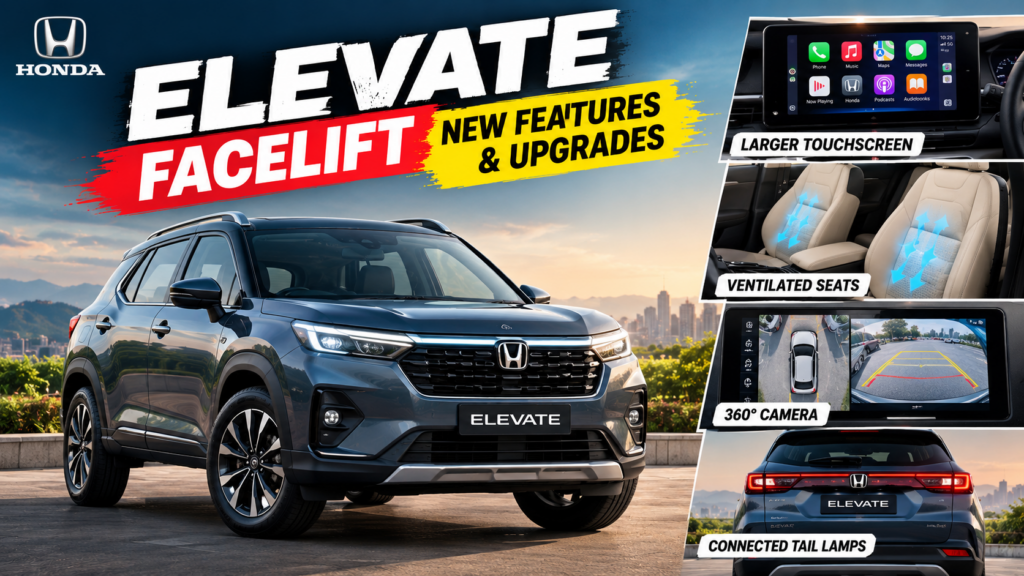
The Honda Elevate is getting a significant update for 2026, with improvements to its exterior styling, cabin comfort, safety equipment and technology. The facelift focuses on making the midsize SUV more feature-rich while retaining the practical design and naturally aspirated petrol engine that define the current model.
The biggest highlights include a revised front grille, a 360-degree camera, ventilated front seats, electric seat adjustment, rear disc brakes and an updated Honda Sensing driver-assistance system. Honda is also introducing new interior themes and a new ZX Plus flagship variant.
Despite these changes, the Elevate continues to prioritise everyday usability, cabin space and straightforward petrol-powered driving rather than switching to a strong-hybrid powertrain.
Honda Elevate Facelift: Exterior Design Updates
The updated Honda Elevate receives a refreshed front profile that gives the SUV a more contemporary appearance. The revised grille and repositioned Honda badge create a cleaner front-end design, with a connected-light-bar look that adds to its visual appeal.
The SUV retains its LED headlamps and fog lamps, while a new front camera helps complete the 360-degree surround-view camera system. This is particularly useful when parking in tight spaces or navigating crowded urban roads.
The facelift also retains 17-inch alloy wheels on higher variants, integrated roof rails and the SUV’s upright proportions. Its 220mm ground clearance remains a practical advantage for dealing with uneven roads, speed breakers and rough patches.
At the rear, the updated model features LED tail lamps with a connected-look design. The overall shape remains familiar, preserving the Elevate’s relatively simple and functional SUV styling.
Boot capacity continues to stand at 458 litres, making the Elevate suitable for family trips, airport runs and everyday luggage requirements.
Honda has retained a conventional single-pane sunroof rather than introducing a panoramic unit. Buyers who prioritise a large glass roof may find this disappointing, but the existing layout keeps the cabin design relatively straightforward.
Interior Gets a More Premium Feel
The cabin receives several important upgrades, particularly in terms of colour options, front-seat comfort and convenience features.
New Ivory and Black Interior Theme
The updated Elevate introduces an Ivory and Black dual-tone interior alongside an all-black cabin option. The ZX Plus Black variant focuses on a darker appearance, giving buyers a more distinctive alternative to the lighter interior treatment.
The changes help refresh the cabin without completely altering the dashboard layout or the SUV’s overall ergonomics.
10.25-Inch Touchscreen and Connected Features
The Elevate continues with a 10.25-inch touchscreen infotainment system supporting wireless Apple CarPlay and Android Auto. These features allow compatible smartphones to connect without requiring a physical cable for everyday use.
The system is paired with a semi-digital driver display, steering-mounted controls and paddle shifters on applicable variants.
The combination should appeal to buyers who want modern connectivity without sacrificing the familiar physical controls needed for regular driving.
Ventilated Front Seats and Electric Adjustment
One of the most useful additions is ventilated front seating. In India’s hot weather, ventilated seats can improve comfort during long journeys and stop-and-go traffic.
The updated SUV also offers electric adjustment for both the driver and front passenger, depending on the variant. However, memory settings are not included, so the seats do not automatically recall multiple saved seating positions.
These upgrades make the cabin feel more premium, especially for buyers considering the higher variants.
Improved Wireless Charging Placement
Honda has repositioned the wireless charging pad beneath the front armrest. The revised layout provides a dedicated charging control and leaves the area below the air-conditioning controls available for a phone slot, Type-C charging port and 12V power socket.
The change is designed to improve everyday usability by making the charging area more organised and keeping essential connections within easier reach.
Rear Seat Comfort and Practicality
The Honda Elevate has traditionally offered a spacious cabin, and the facelift continues to focus on rear passenger comfort.
Rear occupants benefit from generous knee room and headroom, making the SUV suitable for families that regularly travel with adult passengers in the back. Improved side cushioning for the outer rear seats also helps provide a more supportive seating position.
Rear AC vents remain available, while dual Type-C charging ports give passengers convenient access to device charging.
The rear centre armrest has also been updated to sit higher than before, improving its positioning for passengers using it during longer journeys.
However, integrated rear-door sun blinds are still absent. Buyers who frequently travel with children or passengers sensitive to direct sunlight may want to consider this omission before making a purchase.
Safety Equipment and Honda Sensing ADAS
Safety is another important area of improvement on the updated Elevate.
The SUV adds rear disc brakes alongside equipment such as six airbags, ABS and EBD, with the availability of specific features depending on the variant. The 360-degree camera and additional parking sensors also improve visibility when manoeuvring the vehicle.
Camera-Based Honda Sensing
The updated model features Honda Sensing driver-assistance technology using a camera-based system rather than a dedicated front radar unit.
Camera-based systems can identify lane markings, vehicles and other road users, depending on the functions supported by the vehicle. Their performance can be affected by poor visibility, worn road markings and environmental conditions.
A notable addition is the low-speed follow function, designed to help manage the distance from the vehicle ahead in stop-and-go traffic. This can make driving in congested conditions less tiring, although the driver must remain attentive and ready to take control.
ADAS should be treated as a driver-assistance system, not a replacement for safe driving. Buyers should also check the exact functions offered on their chosen variant before booking.
Engine and Transmission: No Strong Hybrid Option
The Honda Elevate facelift retains the familiar 1.5-litre naturally aspirated petrol engine. Buyers can choose between a six-speed manual transmission and a CVT automatic, depending on the variant.
The naturally aspirated engine prioritises predictable power delivery and everyday usability rather than the stronger low-speed torque associated with turbocharged petrol engines.
The manual gearbox may suit buyers who prefer direct control, while the CVT is likely to appeal to those who spend considerable time in city traffic.
Importantly, the facelift does not introduce a strong-hybrid powertrain. The Elevate’s platform has not been designed to accommodate the strong-hybrid setup found in some competing models.
Dealer-fitted CNG solutions may be available for select manual variants, but buyers should confirm compatibility, warranty conditions, installation quality and boot-space implications directly with an authorised dealer.
For customers who specifically want a factory-developed strong hybrid, the Elevate’s conventional petrol configuration remains a key consideration.
New ZX Plus and ZX Plus Black Variants
Honda is introducing the ZX Plus as the new flagship trim, alongside the ZX Plus Black variant.
The higher variants bring together several of the facelift’s headline features, including the updated cabin treatment, additional convenience equipment and enhanced camera-based safety technology.
The Black variant offers a darker interior appearance for buyers who prefer a sportier cabin theme.
As equipment can vary across the range, prospective buyers should compare the official variant-wise feature list rather than assuming that every upgrade is available on the entry-level model.
Warranty and Long-Term Ownership
Honda offers extended warranty packages of up to 10 years, subject to the applicable programme’s terms and conditions.
This can provide additional peace of mind for buyers planning to keep the SUV for several years. However, the maximum warranty duration should not be confused with unconditional coverage of every component for ten years.
Before purchasing an extended package, owners should check the kilometre limits, exclusions, servicing requirements and components covered. They should also confirm whether the coverage is transferable if the vehicle is sold.
The Elevate’s conventional petrol powertrain may appeal to buyers who prefer to avoid the additional components associated with a hybrid system, although routine servicing, fuel costs and the exact warranty terms remain important ownership considerations.
Should You Consider the 2026 Honda Elevate Facelift?
The updated Elevate focuses on addressing several feature-related shortcomings while preserving its core strengths. The addition of a 360-degree camera, ventilated front seats, electric seat adjustment and rear disc brakes makes the SUV more competitive for buyers looking at well-equipped midsize models.
Its spacious cabin, 458-litre boot and 220mm ground clearance continue to support its practical family-SUV positioning. The familiar 1.5-litre petrol engine and manual or CVT options also give buyers a straightforward choice based on their driving preferences.
There are still compromises. The absence of a panoramic sunroof, rear-door sun blinds and a strong-hybrid option may matter to some buyers. The final decision will also depend on pricing, variant-wise equipment and how the updated Elevate compares with its rivals.
Overall, the 2026 Honda Elevate facelift is a meaningful equipment-focused update rather than a complete mechanical overhaul. Buyers who value cabin comfort, practical space, useful safety technology and conventional petrol power should keep it on their shortlist.