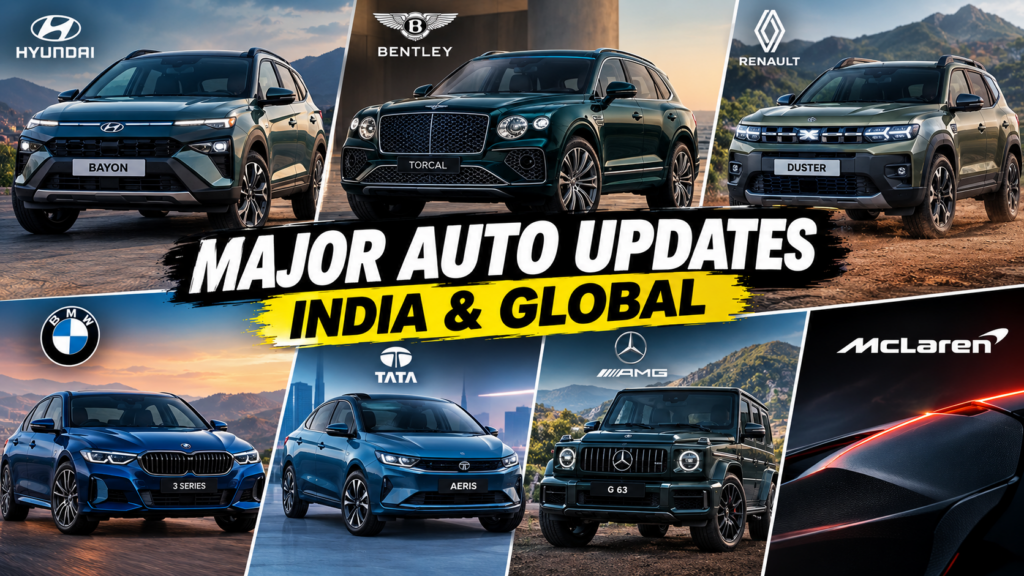
The Indian automotive market is entering an exciting phase with several new SUVs, hybrids, luxury cars and performance models either launching or preparing to enter the country. From Hyundai’s upcoming Bayon to Renault’s new Duster Hybrid and Tata’s latest Aeris compact sedan, manufacturers are expanding their portfolios across multiple segments.
At the same time, global luxury brands are introducing powerful new electric and performance vehicles, while BMW is moving its iconic 3 Series into the Neue Klasse era.
Here are the biggest automotive updates currently making headlines.
Hyundai Bayon Confirmed for India
Hyundai has officially confirmed the Bayon for the Indian market, adding another SUV to its already extensive portfolio. The company revealed the Bayon name in September and subsequently opened bookings at an initial amount of ₹11,000. Hyundai says the SUV will arrive during the festive season.
The Bayon is being positioned as an intelligent utility vehicle designed specifically with Indian customers in mind. Hyundai has highlighted its new design language, technology and urban-focused positioning.
The SUV will sit within Hyundai’s broader SUV range, giving buyers another option between the smaller Venue and larger Creta. It is also expected to compete with models such as the Maruti Suzuki Victoris.
Petrol Engine and Transmission Options
Hyundai has confirmed that the Bayon will use a petrol powertrain with manual and IVT automatic transmission options. However, the company has not yet officially confirmed all engine specifications or a factory-fitted CNG version.
Hyundai is also highlighting an in-built generative AI voice assistant, which could become one of the SUV’s most distinctive technology features.
The Bayon is being engineered around Hyundai’s Global K Enhanced Platform, with the company stating that the vehicle has been developed with Indian safety requirements in mind.
With bookings already open, the Bayon is expected to become one of Hyundai’s most important new launches for the festive season.
Bentley Torcal: The Brand’s First All-Electric SUV
Bentley has entered a new era with the introduction of its first all-electric SUV, the Bentley Torcal.
The performance-focused Torcal S produces up to 888PS and 1,350Nm from its twin electric motors, making it the most powerful production Bentley yet. Bentley quotes a 0–100km/h time of just 2.9 seconds with launch control.
The figures are remarkable for a luxury SUV. The massive torque output is available through the electric powertrain, allowing the Torcal to deliver immediate acceleration.
Bentley has also focused heavily on luxury and technology. The Torcal features a minimalist cabin design, advanced passenger-wellbeing technology and a large curved OLED display.
The company describes the Torcal as its first all-new model in a decade and a major step towards its electric future.
An India launch has not been officially confirmed yet, so any India-specific pricing or launch timeline should currently be treated as an expectation rather than confirmed information.
Renault Duster Hybrid Coming to India
Renault is preparing to bring a strong-hybrid version of the new Duster to India.
The company’s official India website lists the 1.8-litre E-Tech strong-hybrid powertrain, which combines a petrol engine with a 1.4kWh battery and two electric motors. The system uses an eight-speed DHT transmission.
Renault says the hybrid system can operate in electric mode for a significant portion of everyday driving, helping reduce fuel consumption. Regenerative braking also allows energy to be recovered and stored in the battery.
The new Duster will also be available with conventional turbo-petrol engines. The 1.3-litre TCe 160 produces 163PS and 280Nm, while the TCe 100 produces 100PS and 166Nm.
The strong-hybrid version is scheduled to become available around the Diwali 2026 period, according to Renault India.
For Indian buyers, the hybrid Duster could become an important alternative to models such as the Toyota Hyryder, Maruti Grand Vitara and other electrified SUVs.
Eighth-Generation BMW 3 Series Enters the Neue Klasse Era
BMW has unveiled the eighth-generation 3 Series, bringing the iconic sedan into its Neue Klasse era.
The new generation will be offered with both combustion and electric powertrains. BMW says the range launches with two fully electric models and three combustion variants, while a plug-in hybrid will join the line-up later.
The petrol range starts with the BMW 318, producing 156hp, followed by the BMW 320 with 211hp. Both use four-cylinder petrol engines paired with 48V mild-hybrid technology.
At the top sits the new BMW M350 xDrive.
Instead of the 426hp figure mentioned in some early reports, BMW’s official global specification lists the M350 xDrive at 443hp and 580Nm. Its 3.0-litre six-cylinder engine works with a 48V system and allows the sedan to accelerate from 0–100km/h in 4.1 seconds.
The electric side of the range is equally significant. The new BMW i3 50 xDrive produces 469hp and offers up to 912km of claimed range, while the i3 40 xDrive produces 374hp with up to 710km of range. Both use BMW’s latest 800V charging technology.
This makes the new 3 Series one of BMW’s clearest demonstrations of its strategy to offer customers multiple powertrain choices on the same model line.
BMW 100 Jahre Nürburgring Editions Coming to India
BMW is also bringing an extremely exclusive collection of M cars to India to celebrate the upcoming 100th anniversary of the Nürburgring.
The Indian line-up includes the BMW M3, M5 Touring, M5 Sedan, M4 Coupe and M2, with pre-orders now open. The M5 Touring will make its first appearance in India as part of this special collection.
The special editions receive Nürburgring-inspired detailing, including Nürburgring Green paint, special graphics, anniversary badges and an exclusive interior treatment.
BMW M says the anniversary editions are available to order from September 2026. However, BMW has not specified an India allocation of 100 units for the cars; the 100-unit limitation mentioned in official BMW M material applies to the three accompanying BMW Motorrad anniversary motorcycles globally.
The special editions are primarily aimed at collectors and enthusiasts who want something significantly rarer than the standard M cars.
Tata Aeris Replaces the Tigor
Tata Motors has officially replaced the Tigor with the new Aeris compact sedan.
The Aeris was launched in September with introductory prices ranging from ₹5.29 lakh to ₹9.74 lakh ex-showroom. It is available in five trims: Smart, Pure, Pure Plus, Creative and Accomplished.
The biggest change is not only the name but Tata’s attempt to reposition the sedan toward private buyers. The company continues to cater to fleet customers through the Xpres range, while the Aeris is aimed at personal buyers.
Petrol and CNG Powertrains
The Aeris continues with a familiar 1.2-litre three-cylinder naturally aspirated petrol engine.
The petrol version produces around 86hp and 113Nm and can be paired with a five-speed manual or AMT gearbox. The iCNG version develops around 76hp and 97Nm and is also available with manual and AMT transmissions.
One of the biggest advantages of the CNG version is Tata’s twin-cylinder technology, which helps preserve usable boot space.
The Aeris also receives a significant equipment upgrade, including a 10.25-inch touchscreen, wireless smartphone connectivity, wireless charging, ventilated front seats and a digital instrument display. Higher variants can also get features such as a 360-degree camera and blind-view monitoring.
The Aeris is positioned against the Maruti Suzuki Dzire, Hyundai Aura and Honda Amaze.
Mercedes-AMG G 63 Off-Road Pro
Mercedes-AMG has expanded the G-Class line-up in India with the G 63 Off-Road Pro, aimed at customers who want even greater off-road capability from the performance SUV.
The G 63 continues to use a 4.0-litre twin-turbo V8 producing 585hp and 850Nm. Mercedes lists a 0–100km/h time of 4.4 seconds and a 220km/h top speed.
The Off-Road Pro package adds equipment designed to improve performance away from paved roads, including AMG Active Ride Control and specialised off-road technology.
Mercedes-Benz India’s official website currently lists the G 63 Off-Road Pro as part of its performance SUV portfolio.
Its combination of a powerful V8 engine, sophisticated suspension and traditional G-Class construction makes it one of the most expensive and capable performance SUVs available to Indian buyers.
McLaren Updates Its Brand Identity
McLaren has also been making changes away from its vehicles themselves, with the British supercar manufacturer moving toward a more simplified visual identity.
The brand’s modern identity continues to emphasise its racing heritage and minimalist approach, while its current product portfolio includes cars such as the 750S and Artura.
The logo and branding changes are part of McLaren’s wider effort to create a more consistent identity across its road-car and racing operations.
What These Launches Mean for the Indian Market
The latest developments show just how diverse India’s automotive market has become.
At the affordable end, Tata is strengthening its compact sedan range with the Aeris, while Hyundai is preparing the Bayon to add another SUV to its growing portfolio. Renault is targeting the rapidly expanding hybrid segment with the Duster E-Tech.
At the premium end, BMW is preparing a completely new generation of the 3 Series with petrol, hybrid and electric options, while Mercedes-AMG continues to push the limits of the G-Class with the G 63 Off-Road Pro.
Meanwhile, Bentley’s Torcal demonstrates how quickly the luxury segment is moving toward high-performance electric vehicles.
The biggest trend is therefore not the disappearance of one powertrain in favour of another. Instead, manufacturers are offering customers more choices—petrol, mild hybrid, strong hybrid, plug-in hybrid and fully electric—depending on their requirements.
For Indian buyers, this means the coming years could offer more variety than ever before, from affordable CNG sedans and compact SUVs to high-performance electric luxury vehicles.