
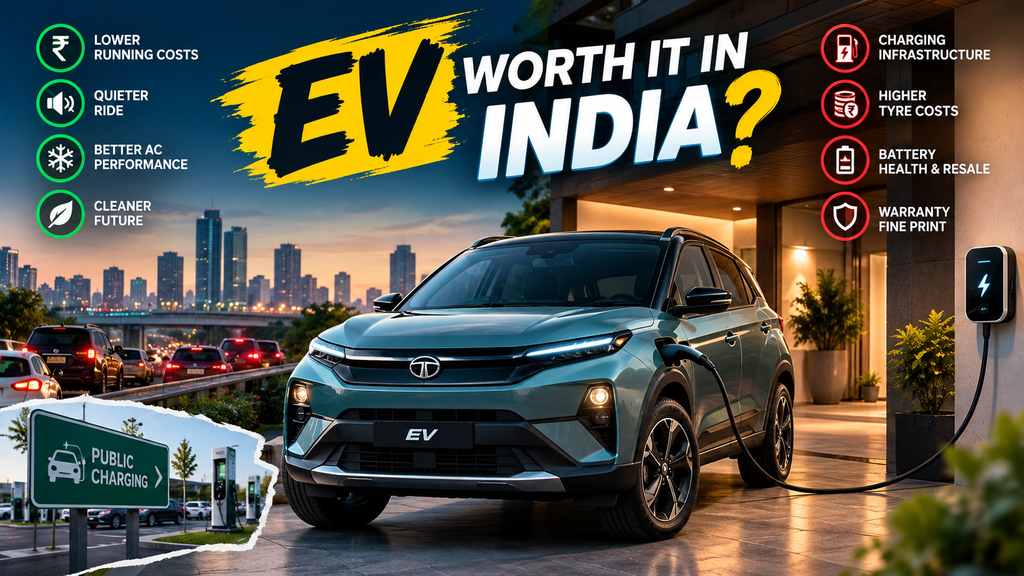
Electric cars have become increasingly attractive in India thanks to lower running costs, instant performance and a much quieter driving experience. However, EV ownership is not equally convenient for everyone.
One of the biggest factors that can completely change the ownership experience is access to home charging. If you have a dedicated parking space where an AC charger can be installed, an EV can make a lot of sense. Without one, daily charging can become considerably more complicated.
India’s public charging network is expanding rapidly, but the infrastructure is still developing. As of March 2026, India had around 27,700 installed public EV charging stations, with roughly 22,750 reported as operational.
So, should you buy an EV in India right now? Here are the major factors to consider.
Public Charging Is Still the Biggest Challenge
For an EV owner with home charging, plugging in the car overnight can become as routine as charging a smartphone. But for someone dependent entirely on public chargers, the experience can be very different.
A typical AC home charger can take several hours to fully charge an EV, depending on the vehicle and charger capacity. DC fast chargers are much quicker and can significantly reduce charging time, but they are more expensive and are not available everywhere.
The bigger issue is the number and distribution of chargers. India has expanded its charging network significantly, but the number of operational chargers remains relatively small compared with the growing EV population. Industry data also puts the number of EVs per operational public charger at well above 200.
This can become particularly inconvenient during busy hours, weekends and long highway journeys.
The Problem of Charging-Space Misuse
Another issue is charging etiquette.
Some EV owners leave their vehicles parked in charging bays even after the battery is fully charged. At the same time, petrol and diesel cars sometimes occupy EV charging spaces.
This creates unnecessary waiting and makes public charging less predictable.
Why Home Charging Changes Everything
The biggest advantage of an EV appears when you can charge it at home.
For city driving, home-charged EVs can have dramatically lower running costs than comparable petrol cars. Depending on electricity tariffs and the vehicle, the effective charging cost can be around ₹1–2 per km, while petrol cars in heavy city traffic can easily cost several times more.
Home charging also removes one of the biggest frustrations of EV ownership: waiting.
Instead of planning your day around a charging station, you can simply plug the car in after returning home and start the next morning with a charged battery.
This is why having a dedicated parking space with charging access should be considered almost as important as the EV itself.
EVs Are Excellent City Cars
When used primarily in the city, electric cars have several advantages over conventional petrol and diesel vehicles.
Lower Running Costs
Electric motors are extremely efficient, and charging at home can make everyday commuting considerably cheaper.
For someone driving long distances every day, the savings can become significant over several years.
One-Pedal Driving
Regenerative braking allows the car to recover energy while slowing down. Strong regenerative braking can also reduce the need to constantly move between the accelerator and brake pedals in stop-and-go traffic.
This makes EVs particularly comfortable in congested cities.
Better Air-Conditioning Performance
An EV’s air-conditioning compressor is electrically powered rather than being directly dependent on engine speed.
That means the air conditioner can continue operating efficiently even when the car is stationary in traffic.
Quiet and Refined
With no conventional engine, EVs are naturally quieter than petrol and diesel vehicles.
Manufacturers have also started adding additional insulation and acoustic treatments to make the cabin even quieter.
But EVs Have Their Own Hidden Costs
Low running costs don’t mean that EVs are automatically cheaper to own in every situation.
Higher Tyre Costs
Electric cars are generally heavier than comparable petrol cars because of their large battery packs.
That additional weight can increase tyre wear, while some EVs require tyres with specific load ratings and low rolling resistance characteristics.
For larger EVs, replacement tyres can therefore be considerably more expensive.
Resale Value Remains a Concern
Resale is another important consideration.
The used-EV market is still developing in India, and resale prices can depend heavily on battery condition, remaining warranty, vehicle age, charging history, software and the availability of newer EVs. Industry analysis also highlights battery health and remaining warranty as major factors affecting used-EV values.
This means buyers should not look only at the initial purchase price. The expected resale value should also be considered.
Battery Health Matters
The battery is the most important component of an EV and one of its most expensive parts.
Frequent use of high-power DC fast charging can generate additional heat and, depending on the vehicle and charging conditions, may contribute to faster battery degradation compared with regular AC charging.
For this reason, buyers should understand the manufacturer’s battery warranty, battery-health conditions and charging recommendations before purchasing.
Don’t Ignore the Warranty Fine Print
Before buying an EV, check exactly what the battery warranty covers.
Look for:
- Warranty duration and kilometre limit
- Minimum battery health guarantee, if applicable
- Whether the warranty transfers to the second owner
- Conditions that can void the warranty
- Coverage for battery damage caused by accidents or flooding
- Separate motor and high-voltage component coverage
Battery warranty has become an important selling point in the Indian EV market, but the actual terms can vary significantly between manufacturers.
Who Should Buy an EV in 2026?
For buyers with a dedicated parking space and the ability to install a home charger, an EV can be an excellent choice.
It is particularly attractive for people who:
- Drive mainly in the city
- Cover high daily kilometres
- Have predictable parking
- Can charge overnight
- Want low running costs
- Prefer a quiet and smooth driving experience
For this type of buyer, models such as the Tata Tiago EV, Tata Punch EV, MG Windsor EV and Kia Syros EV can make sense depending on budget and requirements.
Who Should Wait?
If you live in an apartment without a guaranteed charging point, or regularly depend on public chargers, the decision becomes more complicated.
The same applies to buyers who frequently undertake long highway journeys and don’t have reliable fast chargers along their regular routes.
In such cases, a petrol, diesel or hybrid vehicle may still offer greater convenience.
The Indian charging network is expanding rapidly, but industry and government documents continue to identify charging infrastructure, resale uncertainty and battery-related concerns as important barriers to wider EV adoption.
A Practical EV Buying Strategy
For many households, the most sensible approach could be to use an EV as a city-focused second car rather than the only car.
A relatively affordable EV such as the Tiago EV or Punch EV can handle daily commuting while an existing petrol or diesel vehicle can be used for long highway trips.
For buyers with a larger budget, newer EVs offering real-world ranges in the 400–500 km region can make long-distance travel easier, but charging infrastructure should still be checked along frequently used routes.
Final Verdict
Electric cars are no longer simply an experiment in India. They can deliver excellent performance, extremely low running costs and a superior city-driving experience.
But charging access remains the deciding factor.
If you have dedicated home parking and can install an AC charger, an EV can be one of the most convenient and economical cars for daily use.
If you don’t have reliable access to charging, however, the advantages can quickly be overshadowed by public-charging queues, longer charging times and trip planning.
For now, the simplest rule for Indian buyers is this:
Have home charging? An EV is worth seriously considering.
No dedicated charging access? A petrol, diesel or hybrid car may still be the more practical choice.