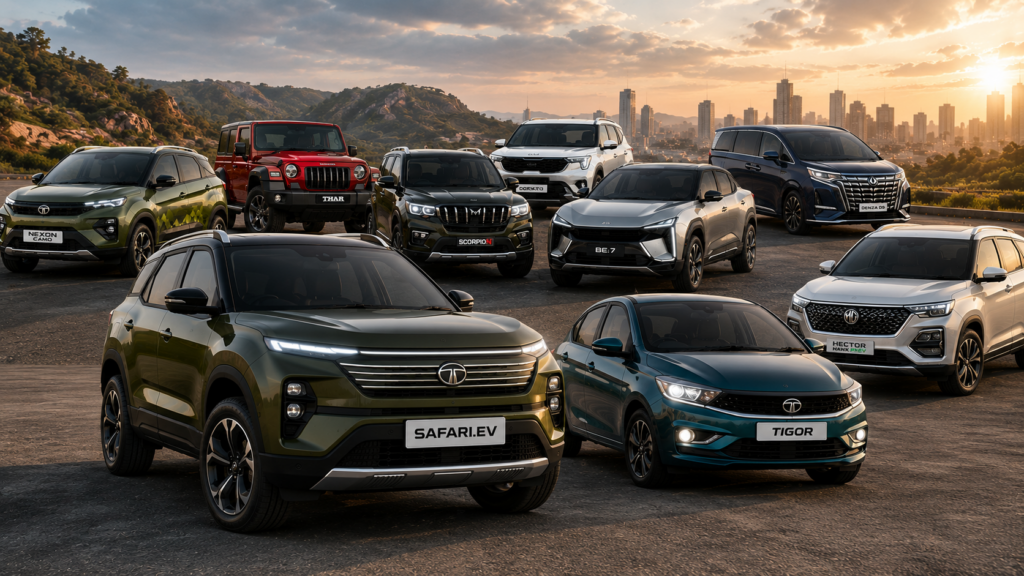
The Indian automobile market is heading into an exciting phase, with several new SUVs, electric vehicles and facelifted models expected to arrive in the coming months. From Tata Motors’ growing electric portfolio to Mahindra’s aggressive SUV strategy, manufacturers are preparing products across multiple price segments.
At the same time, the government’s renewed focus on compressed biogas could give CNG-powered vehicles another interesting fuel option in the years ahead.
Here are the biggest upcoming car launches and automotive developments to watch in India.
Tata Safari EV: A New Electric Flagship
Following the introduction of the Harrier EV, Tata Motors is preparing the electric version of its flagship Safari SUV.
The Safari EV is expected to use Tata’s Acti.ev architecture and could be positioned as a more spacious and family-focused alternative to the Harrier EV. The SUV is expected to feature a large battery pack, with reports pointing towards 65kWh and 75kWh options.
A claimed range of around 600km or more could make the Safari EV one of Tata’s most capable long-distance electric SUVs. The final certified range, however, will depend on the production specification.
The cabin is expected to receive a technology-heavy layout, including a triple-screen dashboard, premium seating and advanced driver assistance features. A high-output electric powertrain with around 500Nm of torque is also expected.
The Safari EV is likely to compete with upcoming electric SUVs from Mahindra and other manufacturers in the premium electric SUV segment. Current industry listings place its expected launch towards the end of 2026, although the exact date is yet to be confirmed.
Tata Tigor Facelift: More Premium, Same Practical Formula
The Tata Tigor is also expected to receive a substantial update before the festive season.
Rather than introducing an entirely new sedan, Tata is expected to give the Tigor a more modern and premium appearance. The redesigned front could feature a more upright SUV-inspired treatment, giving the compact sedan a stronger road presence.
The powertrain lineup is expected to continue with the familiar 1.2-litre petrol engine, while the CNG version should remain an important part of the range.
One of the biggest attractions could be Tata’s twin-cylinder CNG technology, which allows the manufacturer to preserve usable boot space despite the presence of CNG tanks.
The Tigor is expected to remain focused on buyers looking for an affordable family sedan with low running costs. Recent reports also indicate that Tata is preparing updates to both the Tigor and Safari EV as part of its upcoming product strategy.
Tata Nexon Camo Edition: More Features Without a Full Redesign
The Nexon Camo Edition brings another update to Tata’s popular compact SUV.
Unlike a full-generation change, the Camo is primarily a special edition with additional styling and equipment. It introduces colours such as Kurg Cloud and Monarams, along with Camo-specific badging and exterior detailing.
The SUV continues to be offered with petrol, diesel and iCNG powertrain options.
The Camo edition is aimed at customers who want a slightly different appearance while retaining the Nexon’s familiar practicality and powertrain choices.
Mahindra Scorpio N: A Major Equipment Upgrade
Mahindra has strengthened the Scorpio N’s position in the premium SUV market with a major equipment update.
The updated Scorpio N gets a much more modern cabin, including a larger touchscreen infotainment system, digital driver display and panoramic sunroof on higher variants.
Another important addition is Level 2 ADAS, bringing features designed to improve safety during highway driving.
The mechanical package continues to focus on the existing petrol and diesel engines. The Scorpio N’s combination of body-on-frame construction, powerful engines and three-row practicality remains one of its biggest selling points.
Prices for the updated model are expected to span a broad range depending on variant and powertrain.
Mahindra Thar 3-Door Facelift
Mahindra is also expected to update the popular three-door Thar.
The biggest visual change could be the adoption of design elements inspired by the larger Thar Roxx. This could give the three-door SUV a more modern appearance while maintaining its recognizable boxy silhouette.
There is also speculation around additional safety technology, including ADAS.
Another possibility is the introduction of a smaller diesel engine in certain versions. A smaller engine could help Mahindra position the Thar more competitively from a taxation and pricing perspective.
The Thar’s core identity, however, is unlikely to change. It will continue to appeal to buyers looking for a rugged lifestyle SUV with genuine off-road capability.
Mahindra Vision X: A New Compact SUV
Mahindra is also working on a new compact SUV that is expected to sit above the XUV 3XO.
The Vision X is expected to have a sporty design while retaining the upright proportions associated with Mahindra’s SUV lineup. The production model could compete with products such as the Maruti Suzuki Grand Vitara and Tata Curvv.
The new platform is expected to support multiple powertrains, potentially including petrol, diesel, hybrid and electric versions.
Expected equipment includes a panoramic sunroof, ventilated seats, digital displays, a 360-degree camera and Level 2 ADAS.
The production version is expected to arrive in 2027 rather than immediately following the concept unveiling. Current industry estimates place the model in the roughly ₹10.5 lakh to ₹17.5 lakh range, although these figures are not official.
Mahindra BE.7: Another Important Electric SUV
Mahindra’s electric SUV portfolio is also expanding.
The BE.7 is expected to sit among the company’s premium electric offerings and is likely to feature a technology-focused cabin. A triple-screen arrangement is expected to be one of its biggest interior highlights.
Mahindra’s INGLO-based electric vehicles are designed around large battery packs, strong performance and fast charging.
The BE.7 will be important for Mahindra as the company attempts to compete more aggressively with Tata Motors in India’s rapidly expanding electric SUV market.
Kia Sorento: A Premium Fortuner Rival
Kia is preparing to enter another important SUV category in India with the Sorento.
The large three-row SUV is expected to compete with vehicles such as the Toyota Fortuner while offering a more premium cabin and stronger emphasis on technology.
The Sorento is expected to be available with a 1.6-litre turbo-petrol strong hybrid and a 2.2-litre diesel engine. The hybrid powertrain could produce around 230hp, with all-wheel drive expected on higher variants.
Inside, the SUV is expected to offer a premium dashboard with dual 12.3-inch displays, a panoramic sunroof, captain seats, multi-zone climate control, a 360-degree camera and Level 2 ADAS.
Pricing could place the Sorento around the ₹40 lakh mark or higher depending on how Kia chooses to bring it to India. Current industry listings continue to show its launch timing as an estimate, so the final launch date and pricing should be confirmed by Kia.
Kia Seltos Hybrid Could Follow
Kia’s electrification strategy may not stop with the Sorento.
A Seltos Hybrid is also expected to be under consideration for India, potentially using a 1.5-litre hybrid powertrain.
An electronic all-wheel-drive system could also be offered on higher variants.
If introduced, the Seltos Hybrid could become an important alternative for buyers who want better fuel efficiency without moving completely to an electric vehicle.
JSW MG Hector Hawk: EV and Plug-In Hybrid Options
JSW MG is preparing another potentially important addition to its SUV portfolio.
The upcoming model, referred to as the Hector Hawk, is expected to be based on the Wuling Starlight S platform and could be offered in both electric and plug-in hybrid forms.
The plug-in hybrid version is claimed to offer around 125km of electric-only range, while the pure EV could provide approximately 530km on a full charge.
This strategy would give MG access to buyers with different charging requirements. Those who primarily drive in cities could use electric power, while the plug-in hybrid configuration could provide additional flexibility for longer journeys.
BYD Denza D9: Luxury Electric MPV on the Way
BYD is also looking to move further into India’s premium electric vehicle market with its Denza brand.
The Denza D9 is expected to be introduced as a luxury electric MPV, potentially around the festive season.
With its large cabin, premium seating and electric powertrain, the D9 would target a very different audience from mainstream EVs.
A price approaching ₹90 lakh has been suggested, positioning it firmly in the luxury segment.
If launched successfully, the Denza D9 could give Indian buyers another premium electric MPV option beyond conventional luxury SUVs.
Government’s ₹23,731 Crore Push for Bio-CNG
The automotive industry is not the only area undergoing change. India’s fuel ecosystem is also receiving a major policy push.
The Union Cabinet recently approved the GOBARdhan National Circular Bioenergy Scheme with an outlay of ₹23,731 crore. The initiative aims to expand compressed biogas production by using organic waste such as agricultural residue, cattle dung and other biodegradable material.
The government wants to create a larger ecosystem around compressed biogas, helping convert waste into usable energy while reducing dependence on fossil fuels.
This could be particularly relevant for India’s growing CNG vehicle market.
Bio-CNG, or compressed biogas, can be used in CNG-compatible vehicles because of its compatibility with existing CNG systems. This means the growth of Bio-CNG does not necessarily require consumers to purchase a different type of vehicle.
The government’s broader objective is to increase domestic production and create a more circular energy system. Existing GOBARdhan initiatives have already focused on converting animal waste, kitchen waste and agricultural residue into biogas and bio-slurry.
What These Developments Mean for Indian Car Buyers
The next phase of India’s car market is clearly moving beyond simple petrol-versus-diesel choices.
Manufacturers are now developing EVs, strong hybrids, plug-in hybrids, CNG vehicles and advanced petrol and diesel models simultaneously.
Tata is strengthening its electric SUV portfolio with the Safari EV, while Mahindra is rapidly expanding its SUV and EV range. Kia is moving further into premium SUVs and hybrid technology, while JSW MG is exploring EV and plug-in hybrid products.
At the same time, government investment in Bio-CNG could give conventional CNG vehicles a longer future than many expected.
For buyers, this means more choice but also more decisions to make. City users with home charging may find EVs increasingly attractive, while high-mileage users could continue to benefit from CNG and hybrid vehicles.
Final Verdict
The Indian automotive market is entering one of its most competitive periods yet. The Tata Safari EV, updated Tigor, Mahindra Thar, Vision X, BE.7, Kia Sorento, MG’s upcoming hybrid/EV SUV and BYD Denza D9 represent very different approaches to the future of mobility.
What makes the upcoming period particularly interesting is that manufacturers are not abandoning traditional technologies overnight. Petrol, diesel and CNG vehicles are continuing alongside increasingly sophisticated hybrid and electric models.
With new government support for Bio-CNG and an expanding electric vehicle ecosystem, Indian car buyers are likely to have more choices than ever before.
The biggest winners could ultimately be consumers, as manufacturers compete not only on price, but also on technology, efficiency, safety, performance and everyday practicality.