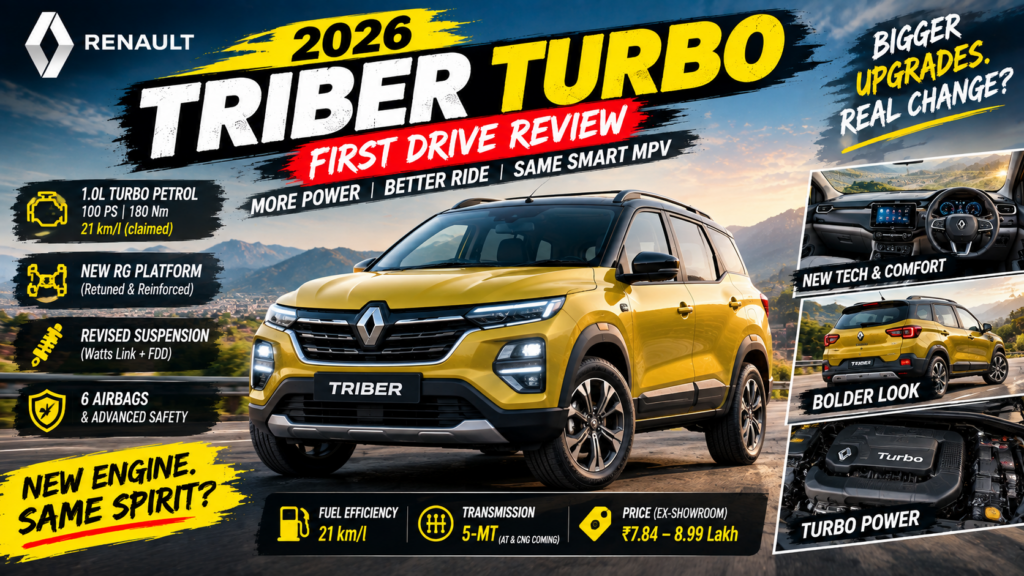
After seven years on the market, the Renault Triber has finally received the performance upgrade many buyers had been waiting for. The 2026 Renault Triber Turbo, now sold as the Triber 100PS, brings a 1.0-litre three-cylinder turbo-petrol engine producing 100 PS and 180 Nm.
More importantly, Renault has not simply dropped a turbo engine into the existing MPV. The company has made extensive changes to the cooling system, chassis, suspension, braking and vehicle dynamics to accommodate the additional performance.
The new turbo-petrol Triber is available with a 5-speed manual gearbox, while automatic and CNG versions are expected to follow. Prices start at ₹7.84 lakh and go up to ₹8.99 lakh (ex-showroom).
New 1.0-Litre Turbo-Petrol Engine
The biggest change is under the bonnet. The Triber now gets Renault’s 1.0-litre TCe 100 turbo-petrol engine, producing 100 PS and a substantial 180 Nm of torque.
The torque figure is particularly important for a seven-seater. The naturally aspirated Triber’s 1.0-litre engine produces 72 PS and 96 Nm, so the turbo version brings a significant improvement when the MPV is carrying several passengers and luggage.
Renault claims a 0–100 km/h time of 10.8 seconds, although real-world testing can take longer depending on conditions. The additional torque is most noticeable once the engine enters its stronger mid-range.
The engine is currently paired exclusively with a 5-speed manual transmission. Renault has tuned the engine specifically for the Triber, with its 180 Nm output higher than the same basic turbo engine’s torque figures in some other Renault applications.
21 kmpl Claimed Fuel Efficiency
Despite the significant increase in performance, Renault claims a fuel efficiency figure of 21 kmpl for the Triber Turbo.
That makes the new engine particularly interesting because buyers do not necessarily have to choose between additional performance and fuel efficiency on paper. However, real-world mileage will depend heavily on throttle use, traffic, passenger load and driving conditions.
During short drives, reviewers have reported considerably lower figures, so the 21 kmpl figure should be treated as the certified claim rather than an expected everyday result.
Fitting the Turbo Engine Required Major Engineering Changes
One of the most interesting aspects of the new Triber is how much Renault had to change underneath the familiar body.
The Triber’s sub-four-metre engine bay is tightly packaged, so fitting the turbocharged HR10/TCe engine required extensive engineering work. Renault revised the thermal-management system and introduced a Brushless DC (BLDC) cooling fan to provide more precise cooling control and improve efficiency.
Structural reinforcements and changes to the suspension and vehicle dynamics were also required.
Because of these extensive revisions, Renault has moved the vehicle onto what it calls the Renault Group Entry Platform (RGEP). The new architecture is designed to support additional powertrain and technology options in the future.
The engineering changes have also added weight, with the turbo version being around 80kg heavier than the earlier configuration according to the drive impressions.
Suspension Gets a Major Upgrade
The additional engine performance meant Renault also had to rework the Triber’s suspension.
The turbo version gets revised suspension geometry along with front and rear anti-roll bars and revised damping. Renault has also tuned the vehicle’s braking and electronic systems to deal with the higher performance.
The result is a more controlled and mature driving experience, particularly at highway speeds. The body feels more planted over undulations compared with the earlier naturally aspirated version.
The suspension changes are important because the Triber’s primary purpose remains family transportation. The objective was not simply to make the MPV faster, but to ensure that the additional performance did not compromise ride comfort or stability.
How Does the Triber Turbo Drive?
On the highway, the turbo engine is where the new Triber makes the biggest impression.
Once the engine gets into its stronger rev range, the additional torque makes overtaking considerably easier. Even with multiple passengers and luggage, the MPV has enough mid-range punch to build speed without requiring excessive effort.
The engine’s stronger response is particularly useful when climbing inclines or making quick overtaking manoeuvres.
In city traffic, however, the character is slightly different.
Below the turbo’s stronger operating range, there can be some hesitation and three-cylinder vibration. The engine also has a noticeable change in response as boost arrives, which means drivers may need to work the gearbox more actively in slower traffic.
The 5-speed manual has a somewhat notchy or knotty shift action, although the clutch itself is light and easy to operate.
Steering Is Lighter, But Not Perfect
The additional weight over the front axle also required changes to the steering setup.
Renault has tuned the steering to keep low-speed manoeuvring easy, making the Triber relatively effortless to drive around town and in tight parking areas.
However, the steering has been described as overly light, particularly compared with what some drivers might expect from a vehicle with the Turbo’s improved performance.
The lighter steering does make the MPV easy to use as a family car, but it does not provide particularly strong feedback at higher speeds.
NVH Remains a Weak Point
The three-cylinder engine continues to make its presence known inside the cabin.
Some vibration can be felt at lower revs, while engine noise becomes more noticeable as the revs rise. Road and wind noise are also evident at highway speeds.
This means the Triber Turbo is not the quietest MPV in its class, although the additional performance helps compensate for some of the earlier engine’s limitations.
For a family-focused vehicle, Renault could have worked further on insulation and refinement, particularly because the Turbo engine encourages drivers to use more of its rev range.
The Triber’s Flexible Seven-Seat Layout Remains
Despite all the mechanical changes, Renault has retained one of the Triber’s biggest strengths: its flexible interior.
The MPV continues to offer configurable seating that allows the second and third rows to be adjusted, folded or removed depending on passenger and luggage requirements.
The third-row Easy-Fix seats and sliding and reclining second row allow the cabin to be configured for different situations.
With the third row removed and the cabin configured for fewer passengers, the Triber can offer significantly more cargo space. Renault quotes up to 625 litres of boot space in the five-seat configuration.
Features and Safety
The Triber Turbo retains the model’s practical cabin and receives a strong equipment package depending on the variant.
Key features include an 8-inch touchscreen infotainment system, wireless Android Auto and Apple CarPlay, a digital driver display, automatic climate control, cruise control and wireless charging.
Higher variants also offer automatic headlights, rain-sensing wipers and a Smart Access Card.
Safety equipment includes six airbags, along with features such as TPMS, front parking sensors and a rear camera depending on the variant.
The turbo version is therefore not simply a performance upgrade. It also brings the Triber closer to the equipment levels expected from a modern family MPV.
CNG and Automatic Versions Are Coming
The new RGEP architecture has also been developed with future powertrain options in mind.
Renault is expected to expand the Triber Turbo range with an automatic transmission and factory-fitted CNG technology. Reports indicate that these versions are planned for a later introduction, giving buyers more choices beyond the current 5-speed manual turbo.
The CNG version is particularly interesting because Renault has been working on a dual-cylinder arrangement designed to preserve the Triber’s practical packaging.
2026 Renault Triber Turbo Price
The new turbo-petrol Triber is offered in three variants:
| Variant | Ex-showroom price |
|---|---|
| Triber Evolution Turbo | ₹7.84 lakh |
| Triber Techno Turbo | ₹8.53 lakh |
| Triber Emotion Turbo | ₹8.99 lakh |
The Authentic variant continues with the naturally aspirated engine, while the Turbo version is currently available in Evolution, Techno and Emotion trims.
2026 Renault Triber Turbo: A Much-Needed Performance Upgrade
The new Renault Triber Turbo represents a significant change for an MPV that has spent years relying on its clever packaging rather than outright performance.
The 100 PS and 180 Nm engine gives the seven-seater substantially more flexibility, particularly when carrying passengers and luggage. The claimed 21 kmpl efficiency also makes the power upgrade more appealing.
But the biggest story is the engineering underneath. Renault has revised the cooling system, structure, suspension, damping, braking and vehicle dynamics rather than treating the turbo engine as a simple bolt-on upgrade.
The result is a Triber that feels more capable on highways while retaining the flexible seven-seat layout that made the MPV popular in the first place.
There are still compromises, particularly the three-cylinder vibrations, noticeable engine and wind noise and the somewhat notchy gearbox. Nevertheless, the new turbo engine addresses one of the Triber’s most obvious limitations and gives Renault’s compact MPV a much stronger powertrain for family use.