Maruti Suzuki is preparing for a major shift in its powertrain strategy, with Suzuki revealing a new family of engines and hybrid systems aimed at different vehicle segments. The technology roadmap includes a new 1.2-litre direct-injection turbo-petrol engine, a Z12E-based series hybrid system, and a smaller 48V hybrid setup for entry-level cars.
The new powertrains are being developed around Suzuki’s broader strategy of improving efficiency while keeping combustion-engine technology relevant alongside electrification. For India, the developments are particularly important because Suzuki has identified the country as one of its growth markets for the new technologies.
1.2-Litre Turbo-Petrol Engine Could Bring More Power to Maruti Cars
The most significant development for the Indian market is Suzuki’s new 1.2-litre three-cylinder direct-injection turbo-petrol engine.
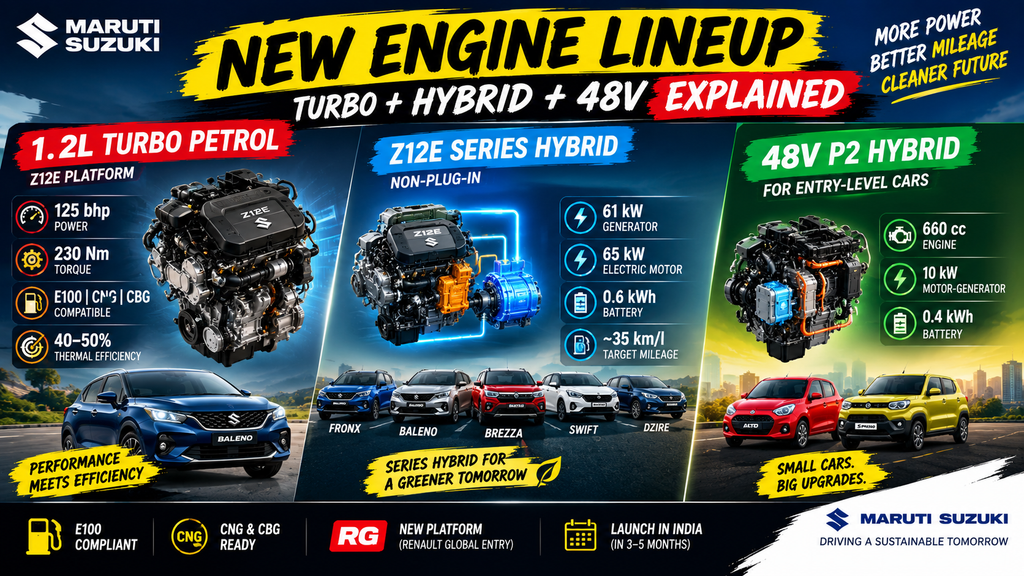
Based on the Z12E architecture already used in cars such as the Swift, Dzire and Baleno, the new turbocharged engine is designed to produce around 125–126hp and 230Nm. Suzuki has developed it with a variable-geometry turbocharger and a water-cooled intercooler.
That torque figure would represent a major jump over the naturally aspirated Z12E currently used in Maruti’s compact cars. The existing Z12E in the Swift, for example, produces 60kW and 111.7Nm according to Maruti Suzuki’s current technology information.
The turbo engine is also being designed to work with E100 fuel, as well as CNG and CBG. Suzuki’s development programme is targeting much higher thermal efficiency over time, with a long-term goal of reaching around 50 percent.
Could the Turbo Engine Come to the Jimny?
One potential application being discussed is the Maruti Suzuki Jimny. A 1.2-litre turbo engine would give the compact SUV substantially more torque than its existing naturally aspirated setup.
However, Suzuki has not officially confirmed the Jimny or any other specific Indian model for this engine. Current reports describe the 1.2-litre turbo as a prototype intended for growth markets, including India.
That means applications such as the Jimny should currently be treated as potential future possibilities rather than confirmed launches.
E100, CNG and CBG Compatibility Is a Major Focus
One of the most interesting aspects of the new engine family is Suzuki’s focus on fuel flexibility.
The 1.2-litre turbo engine is being developed to operate with E100, meaning fuel containing up to 100 percent ethanol, while also supporting CNG and CBG applications.
This approach is particularly relevant to India, where Maruti already has a large CNG portfolio. The company has also continued moving its existing range towards the Z12E engine. The 2026 Baleno, for example, now uses the Z12E engine in both petrol and CNG forms.
The strategy therefore appears to be about creating a common engine architecture that can support several fuel and electrification technologies instead of relying on a single powertrain solution.
Z12E Series Hybrid Could Be Maruti’s Next Big Hybrid Technology
The second major development is the Z12E-based series hybrid system.
Unlike a conventional hybrid where the petrol engine can mechanically drive the wheels, a series hybrid uses the combustion engine primarily as a generator. The electric motor drives the wheels, while the engine generates electricity to power the system and recharge the small battery.
Suzuki’s displayed system uses a 1.2-litre Z12E three-cylinder engine, a 61kW generator motor, a 65kW drive motor and a 0.6kWh battery. The engine itself is rated at around 82bhp and 108Nm in the showcased configuration.
This means the petrol engine does not directly send power to the wheels through a conventional gearbox. Instead, the electric drive motor handles propulsion.
The system is designed for compact vehicles and could provide a more EV-like driving experience without requiring the large battery of a fully electric vehicle.
Could the Series Hybrid Deliver Around 35km/l?
One of the biggest attractions of this technology is efficiency.
The series-hybrid system is expected to target very high fuel economy, with reports suggesting a figure around 35km/l for future applications. However, this should be treated as a target or projected figure rather than a confirmed Maruti Suzuki India ARAI-certified number.
Suzuki has confirmed the underlying series-hybrid technology, but it has not officially announced specific Indian models, prices or launch dates for the system.
The compact size of the system makes it particularly relevant to Maruti’s hatchback and compact SUV portfolio.
Fronx, Baleno, Brezza and Other Compact Models Could Benefit
The series-hybrid technology could potentially be adapted for several of Maruti Suzuki’s compact models.
The Fronx, Baleno, Brezza, Swift and Dzire are among the vehicles being discussed in connection with future hybridisation, although Suzuki has not confirmed this model-by-model deployment.
If implemented across these vehicles, the technology could give Maruti a wider hybrid portfolio without requiring the larger battery packs used in plug-in hybrids or full EVs.
It would also complement the company’s existing strong-hybrid technology supplied through Toyota partnerships. Maruti’s current strong-hybrid system combines an internal-combustion engine with an electric motor and lithium-ion battery, with an e-CVT managing the powertrain.
The new series hybrid would take a different approach by making the electric motor the primary source of propulsion.
48V P2 Hybrid for Small and Entry-Level Cars
The third powertrain is aimed at a completely different segment.
Suzuki has also showcased a 48V P2 hybrid system based around a compact 660cc engine. It combines the engine with a 10kW motor-generator and a 0.4kWh battery.
The system has been developed primarily for small vehicles, particularly Suzuki’s kei-car applications in Japan.
The engine can be offered in naturally aspirated or turbocharged forms, while the motor-generator provides electric assistance and energy recovery.
Compared with the Z12E series hybrid, this system is much simpler and uses a considerably smaller battery. That helps keep weight, packaging requirements and costs under control.
Could This Technology Reach the Alto and S-Presso?
The compact nature of the 48V hybrid system makes it suitable for entry-level vehicles.
Cars such as the Alto and S-Presso could potentially benefit from similar technology in the future, particularly if Maruti decides to use the architecture for its smallest Indian models.
However, Suzuki’s displayed 660cc system is primarily designed for the kei-car segment, and there is currently no official confirmation that the exact Japanese setup will be introduced in India.
For India, the important point is that Suzuki is developing hybrid technology that can work with much smaller engines and batteries than conventional strong-hybrid systems.
Three Powertrain Strategies for Three Different Segments
Suzuki’s new technology roadmap effectively creates three different approaches.
| Powertrain | Key Technology | Intended Segment |
|---|---|---|
| 1.2L DITC Turbo | 125–126hp, 230Nm | Compact cars and larger models |
| Z12E Series Hybrid | 65kW electric drive motor, 0.6kWh battery | Compact cars and SUVs |
| 48V P2 Hybrid | 10kW motor-generator, 0.4kWh battery | Mini/entry-level cars |
This gives Suzuki the flexibility to use different technologies depending on vehicle size, price and customer requirements.
The turbo engine focuses on performance and fuel flexibility, the series hybrid prioritises efficiency and electric-driven propulsion, while the 48V system focuses on affordable electrification for small cars.
What It Means for Maruti Suzuki in India
For Maruti Suzuki, this strategy could be particularly significant because the company has one of India’s widest portfolios of small and compact cars.
The Z12E engine is already being expanded across the range. The new Baleno, for example, uses the Z12E in petrol and CNG configurations and delivers up to 24.77km/l with the AGS transmission according to Maruti’s claimed figures.
The next step could be to build additional technologies around the same basic engine architecture.
A turbocharged version could provide significantly stronger performance, while a series-hybrid version could improve efficiency without requiring a large battery. CNG and CBG compatibility could further expand fuel options.
Launch Timeline Remains Unclear
Despite the amount of technology revealed, Suzuki has not confirmed specific Indian launch dates for these new powertrains.
Recent reports describe the 1.2-litre turbo engine as a prototype and say India is one of the intended growth markets. Suzuki has also showcased the series-hybrid and 48V hybrid systems, but model-wise applications, prices and India launch timelines have not yet been announced.
Therefore, claims that these engines will enter production in India within a specific three-to-five-month period should be treated as unconfirmed unless Maruti Suzuki makes an official announcement.
A New Direction for Maruti’s Powertrains
Maruti Suzuki’s future engine strategy appears to be moving beyond the traditional naturally aspirated petrol and mild-hybrid formula.
The new 1.2-litre turbo-petrol, Z12E series hybrid and 48V P2 hybrid represent three different approaches to improving performance and efficiency.
The common theme is keeping the systems compact, efficient and adaptable to different fuels and vehicle segments. For India, the most interesting developments are the E100/CNG/CBG-compatible turbo engine and the Z12E series hybrid, although their exact production models and launch dates remain to be confirmed.
If these technologies make their way into Maruti Suzuki’s mainstream Indian lineup, they could significantly expand the company’s powertrain choices across hatchbacks, compact SUVs and other small vehicles.