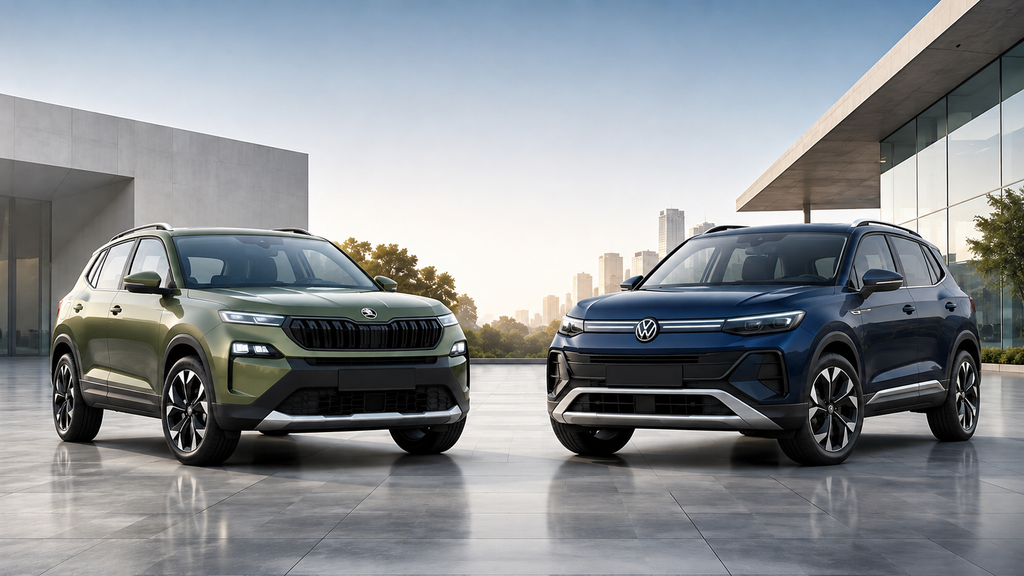
The Indian automotive industry could be heading towards a major strategic shift as Škoda Auto Volkswagen India (SAVWIPL) and the JSW Group move closer to a potential partnership. The proposed alliance could reshape the German automaker’s strategy in India, bringing greater localisation, new electric vehicles and potentially more competitive pricing.
Škoda Auto CEO Klaus Zellmer recently indicated that Volkswagen expects to finalise a local partnership in India during 2026. While the companies have not officially confirmed the final ownership structure, reports suggest that JSW Group is in advanced discussions with SAVWIPL over a proposed joint venture. JSW is also reportedly seeking a majority stake in the venture.
If completed, the partnership could become one of the most important developments for Škoda and Volkswagen in India since the launch of the India 2.0 strategy.
JSW and Volkswagen Are Moving Closer to a Partnership
Škoda Auto Volkswagen India and JSW Group are reportedly in the final stages of discussions for a manufacturing joint venture. Earlier reports suggested that the two sides could sign a non-binding Memorandum of Understanding, with a structure being discussed around a 51:49 ownership arrangement that would give JSW the majority stake.
However, the final ownership structure and scope of the partnership have not yet been officially announced.
For JSW, the proposed deal would significantly expand its presence in India’s passenger vehicle industry. The group is already involved in the automotive sector through JSW MG Motor India, but the proposed Škoda-Volkswagen venture would operate separately rather than becoming a merger between the two businesses.
For Volkswagen Group, meanwhile, a partnership with a large Indian conglomerate could provide the local expertise and financial support needed to scale its operations faster.
Why Does Volkswagen Need a Local Partner?
Volkswagen and Škoda already have extensive manufacturing and engineering capabilities in India. However, building significant scale in the world’s third-largest automobile market remains challenging.
India’s automotive industry requires manufacturers to understand a complex combination of local suppliers, taxation, regulations, pricing expectations and rapidly changing consumer preferences.
A strong local partner could help Volkswagen navigate this ecosystem more efficiently.
Škoda has already demonstrated the benefits of developing products specifically for Indian customers. The Kushaq, Slavia and Kylaq were developed around a high-localisation strategy, with the MQB-A0-IN platform created specifically for the Indian market.
The Kylaq is particularly important because it gave Škoda an entry into India’s enormous sub-4-metre SUV segment.
The company has also significantly increased its manufacturing scale. SAVWIPL recorded 117,000 domestic sales in 2025 and crossed the milestone of two million locally built vehicles.
The next challenge is to take this strategy into electric vehicles.
€2 Billion Investment Could Accelerate New EVs
One of the biggest reasons the proposed partnership is attracting attention is the investment planned for India’s next phase of Volkswagen Group’s strategy.
Reports indicate that Volkswagen Group could invest around €2 billion over the coming decade in India. The investment would cover several projects involving electric vehicles, product development, engineering, manufacturing and localisation.
A significant part of this strategy is expected to revolve around the India Main Platform (IMP).
Rather than developing a completely new electric vehicle architecture from scratch, Volkswagen is expected to adapt its existing China Main Platform (CMP) for India.
The locally adapted platform could be modified to meet Indian safety regulations, work with Indian suppliers and achieve a much higher level of localisation. This approach could reduce development costs and shorten the time required to bring new EVs to market.
The platform could eventually underpin a new generation of electric SUVs from Škoda and Volkswagen.
Electric SUVs Could Be the Biggest Beneficiaries
The partnership could become particularly important as India moves towards greater electrification.
Škoda and Volkswagen currently have a relatively limited locally manufactured EV presence compared with some of their rivals. Developing affordable electric SUVs specifically for India would allow the brands to compete in one of the fastest-growing areas of the market.
The use of a localised EV platform could also help reduce production costs.
That matters because electric vehicles remain significantly more expensive than comparable petrol cars in many segments. Greater localisation of batteries, components and other systems could eventually allow Škoda and Volkswagen to bring their EVs closer to mainstream Indian price points.
For buyers, this could mean more European-brand electric SUVs with competitive driving ranges, modern technology and lower running costs.
Kylaq Success Has Changed Škoda’s Approach
The success of the Škoda Kylaq appears to have strengthened the company’s belief in designing and engineering vehicles specifically for India.
The Kylaq is Škoda’s first sub-four-metre SUV and was developed using the locally engineered MQB-A0-IN platform. The platform was created jointly by Indian and Czech engineering teams, with a focus on localisation, lower operating costs and faster product development.
The model quickly became an important part of Škoda’s Indian strategy.
The company had previously stated that the Kylaq would play a major role in its goal of reaching 100,000 annual sales in India by 2026.
Its importance goes beyond sales numbers. The Kylaq demonstrated that a product designed around Indian requirements can help a European manufacturer expand into highly competitive segments.
This could encourage Škoda and Volkswagen to develop more India-focused models rather than simply adapting vehicles created for other global markets.
What Could Change for Indian Customers?
If the JSW-Volkswagen partnership is finalised and the planned investment moves ahead, Indian customers could eventually benefit in several ways.
More Localised Cars
Higher localisation could reduce the dependence on imported components and help manufacturers control production costs.
More Competitive Pricing
Lower manufacturing and development costs could allow Škoda and Volkswagen to compete more aggressively against brands such as Maruti Suzuki, Hyundai, Tata Motors and Mahindra.
More Electric SUVs
The India Main Platform could provide the foundation for multiple locally produced electric models rather than a single standalone EV.
Lower Ownership Costs
Greater localisation could also reduce parts and manufacturing costs, potentially making maintenance more affordable.
India-Focused Features
Future products could be designed around Indian driving conditions, road infrastructure and customer preferences from the beginning.
A Potentially Important New Chapter for Volkswagen in India
The proposed JSW partnership comes at an important time for Volkswagen Group.
The company has already invested heavily in developing local products and manufacturing capabilities. Its India 2.0 strategy created the foundation for the Kushaq, Slavia, Kylaq, Taigun and Virtus, while India has also become an important export base for the group. SAVWIPL has exported more than 700,000 vehicles from India, underlining the country’s growing importance within its global manufacturing network.
The next stage is likely to be electrification.
A financially strong local partner could help Volkswagen spread investment risks, increase localisation and develop products at a scale that makes sense for India’s price-sensitive market.
For JSW, the partnership would provide access to Volkswagen Group’s global technology and engineering capabilities while strengthening its position in India’s rapidly evolving passenger vehicle industry.
The deal is not final yet, and several details — including ownership, operations and the exact scope of the joint venture — still need to be confirmed. But with both sides reportedly moving closer to an agreement, the potential partnership could mark the beginning of a new chapter for Škoda and Volkswagen in India.
If the planned investment, localisation and EV strategy come together successfully, Indian buyers could eventually see a new generation of more affordable, locally engineered Škoda and Volkswagen cars and electric SUVs designed specifically for the Indian market.