
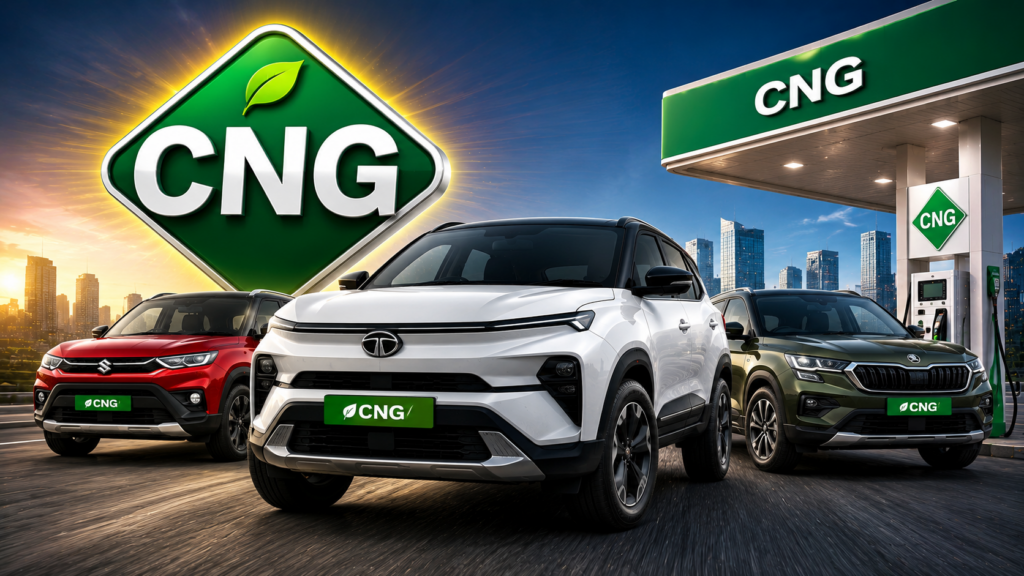
India’s car market is going through a major fuel-powertrain shift. While electric vehicles continue to attract attention, CNG has quietly emerged as one of the biggest winners in the Indian passenger car market.
In FY2026, CNG became the second-most popular fuel type for passenger vehicles, accounting for 21.98% of total sales. Diesel, once the preferred choice for high-mileage buyers, slipped to 18.08%, while electric cars accounted for 4.25%. Around 10.34 lakh CNG passenger vehicles were sold during the financial year.
The numbers explain why manufacturers are rapidly expanding their factory-fitted CNG portfolios. CNG is no longer limited to small hatchbacks. It is now available in SUVs, sedans and larger family cars, while companies are working on solving the traditional disadvantages of CNG, particularly limited boot space.
CNG Has Overtaken Diesel in Popularity
For years, diesel was the preferred fuel for Indian buyers who drove long distances. Better mileage and strong low-end torque made diesel cars particularly popular among highway users, commercial operators and SUV buyers.
But diesel’s share has steadily declined.
CNG, meanwhile, has moved in the opposite direction. Its share increased from 19.60% in FY2025 to 21.98% in FY2026, putting it comfortably ahead of diesel.
There are several reasons behind this shift.
CNG generally offers a lower running cost than petrol, while the expanding CNG refuelling network has made the fuel more practical for private buyers. India’s city gas distribution network now covers more than 600 cities, significantly improving accessibility compared with a few years ago.
For buyers who regularly drive long distances but don’t have convenient access to EV charging, CNG has become an attractive middle ground.
Why Are Buyers Moving Towards CNG?
The biggest reason is simple: running cost.
CNG typically costs considerably less per kilometre than petrol. Although CNG variants usually carry a higher upfront price, frequent drivers can recover that premium relatively quickly.
Fuel-price uncertainty is another factor influencing buyers.
Some consumers are also becoming more cautious about petrol-powered cars because of concerns surrounding ethanol-blended fuels and their long-term impact on fuel economy and vehicle ownership.
EVs are another alternative, but they aren’t ideal for every buyer.
Someone living in an apartment without home charging, or someone who frequently travels between cities where charging infrastructure may be less convenient, can find a CNG car easier to live with.
This combination of low running cost, familiar refuelling and improving infrastructure has helped CNG move beyond its traditional customer base.
CNG Is No Longer Just for Small Hatchbacks
Perhaps the biggest change is where CNG is now available.
Earlier, CNG was strongly associated with cars such as the Maruti Suzuki Wagon R, Alto and Dzire. Today, manufacturers are offering the fuel in increasingly expensive segments.
Tata Motors, for example, offers CNG versions of models including the Punch and Nexon, while Maruti Suzuki has expanded CNG availability across a large portion of its portfolio. Hyundai also offers CNG on selected models such as the Grand i10 Nios, Aura and Exter.
This expansion shows that CNG is no longer being treated simply as a budget-fleet fuel.
Even premium customers are increasingly considering CNG because of its potential fuel-cost savings. Skoda’s management has specifically pointed to the growing CNG penetration in compact SUVs as an opportunity for the brand.
Tata’s Dual-Cylinder Technology Solves the Boot-Space Problem
One of the biggest complaints about older CNG cars was the loss of boot space.
Traditional CNG vehicles often used a large cylindrical tank occupying a significant portion of the luggage compartment. That made them less practical for families.
Tata Motors has addressed this issue with its dual-cylinder CNG technology.
Instead of using one large cylinder, Tata uses two smaller cylinders positioned beneath the boot floor. This frees up considerably more luggage space while still allowing the vehicle to run on CNG.
The technology has helped Tata introduce CNG into SUVs such as the Punch and Nexon without completely sacrificing everyday practicality.
Tata has also pushed CNG technology beyond basic variants. Its newer CNG models can offer features and equipment that buyers would traditionally associate with petrol versions.
Tata Takes CNG Further With Automatic Gearboxes
Another important development is the availability of automatic transmissions with CNG.
Historically, CNG cars were almost always manual because manufacturers focused on keeping the technology simple and affordable.
Tata has challenged that approach by introducing AMT automatic options on selected CNG models.
This is particularly important for urban buyers who spend hours in traffic.
A buyer no longer necessarily has to choose between the fuel savings of CNG and the convenience of an automatic transmission.
Maruti Suzuki Uses Underbody CNG Technology
Maruti Suzuki has taken a different approach in some of its larger vehicles.
Instead of occupying the luggage compartment, the CNG tank can be positioned underneath the vehicle, behind the rear axle.
This approach has a major advantage: the boot can remain practically unchanged.
For larger vehicles where luggage capacity is particularly important, this can be a major selling point.
Maruti has also built significant consumer trust around factory-fitted CNG systems after offering them across its range for years.
However, there are still areas where the company could improve.
Some smaller Maruti models continue to have compromises in luggage space because of their CNG tank arrangement, while automatic CNG options remain limited compared with what some buyers may expect.
Hyundai Still Has a Gap in Its CNG Lineup
Hyundai has also established itself in the factory-fitted CNG market, but its portfolio remains relatively limited.
The company currently offers CNG technology on selected models, including the Grand i10 Nios, Aura and Exter.
The bigger opportunity could be SUVs such as the Venue and Creta.
CNG has already demonstrated strong demand in the compact SUV segment, and industry executives have acknowledged that the market is large enough for manufacturers to take notice.
The question is whether Hyundai will expand its factory-fitted CNG technology into more premium vehicles.
Skoda Could Change the CNG Game With a Turbo Engine
Perhaps the most interesting upcoming development is Skoda’s CNG strategy.
Skoda is actively evaluating factory-fitted CNG powertrains for its 1.0-litre turbo-petrol portfolio, including the Kylaq, Kushaq and Slavia.
This is significant because most CNG cars currently sold in India use naturally aspirated petrol engines.
Skoda’s 1.0-litre TSI, on the other hand, is a turbocharged direct-injection engine.
Combining a turbocharged direct-injection engine with CNG presents considerably greater engineering challenges because of the higher pressures, temperatures and combustion characteristics involved.
Skoda has already explored CNG technology globally under its G-Tec programme, giving the company valuable experience in this area.
The company is now working on how to balance fuel efficiency with the performance expected from its turbocharged engines. Current evaluations suggest a performance reduction may be around 10–15% when running on CNG.
If Skoda successfully brings a factory-developed turbo-CNG powertrain to India, it could create a completely new category of CNG cars.
Why Skoda’s CNG Move Matters
The compact SUV segment is particularly important.
Skoda’s management has said that roughly 20% of the compact SUV segment is already powered by CNG, representing a major opportunity for the Kylaq.
Instead of offering a basic CNG setup simply to improve fuel economy, Skoda could potentially combine:
- Turbocharged performance
- CNG running costs
- Automatic transmission
- Premium interiors
- Strong highway performance
That combination could make CNG attractive to buyers who previously considered petrol the only option for a more enjoyable driving experience.
Honda Is Missing Out on the Factory-Fitted CNG Boom
Honda presents an interesting contrast.
The company does provide CNG options through dealer-level installations using Lovato systems, but this is different from a fully integrated factory-fitted solution.
A factory-developed CNG vehicle can integrate the fuel system more deeply with the vehicle’s electronics, instrument cluster and safety systems.
A dealer-installed system can also create a more complicated ownership experience because the vehicle and CNG system may have separate warranty arrangements.
This becomes particularly important in segments where CNG demand is already high.
The Honda Amaze, for example, operates in a market where CNG has strong relevance, particularly among commercial and high-mileage users.
A factory-fitted CNG Amaze could therefore give Honda another opportunity to compete more aggressively.
CNG vs EV: Which One Makes More Sense?
CNG and EVs are often treated as competitors, but they actually solve different problems.
| Factor | CNG | EV |
|---|---|---|
| Running cost | Low | Very low |
| Refuelling/charging time | Similar to petrol refuelling | Much longer |
| Highway convenience | Strong where CNG stations exist | Depends on charging network |
| Home charging | Not required | Highly desirable |
| Boot-space compromise | Improving rapidly | Usually minimal |
| Long-distance use | Very practical | Depends on infrastructure |
| Emissions | Lower than petrol | Zero tailpipe emissions |
| Upfront cost | Moderate premium | Generally higher |
| Best suited for | High-mileage users without home charging | Users with convenient charging |
For someone with easy access to a CNG station, a CNG car can be extremely practical.
For someone with home charging and predictable daily travel, an EV may be more attractive.
There is no single winner for every buyer.
Is CNG Really the New Diesel?
In terms of market share and buyer momentum, the comparison is becoming increasingly difficult to ignore.
CNG has already overtaken diesel in India’s passenger vehicle market. At 21.98% of FY2026 sales, it is now firmly established as the country’s second-most popular passenger-car fuel.
But CNG is not necessarily replacing diesel in every application.
Diesel remains important for larger SUVs, commercial vehicles and buyers who prioritise long-distance highway performance and high torque.
What CNG is replacing is the idea that affordable, fuel-efficient motoring must come with major compromises.
Dual-cylinder systems, underbody tanks, better integration and even automatic transmissions are making CNG cars significantly more practical than they were a decade ago.
What the Future of CNG Cars Looks Like
The next phase of India’s CNG market could be even more interesting.
Manufacturers are moving CNG into SUVs and higher price segments, while companies such as Skoda are investigating turbocharged CNG powertrains.
At the same time, CAFE regulations are encouraging manufacturers to reduce fleet-level emissions, making lower-emission powertrains increasingly important to automakers.
The result is a market where petrol, CNG, hybrids and EVs are all competing for different types of customers.
CNG’s rapid rise shows that Indian buyers aren’t necessarily looking for the most technologically advanced powertrain. They are looking for a combination of affordability, practicality, low running costs and convenience.
And right now, CNG is delivering that combination particularly well.
Final Verdict
CNG has genuinely become one of the biggest powertrain stories in India’s car market.
With nearly 22% market share in FY2026, growing infrastructure and increasingly sophisticated vehicle technology, CNG has moved far beyond its old image of being a taxi or budget-car fuel.
Tata has made it more practical with dual-cylinder technology, Maruti has refined the underbody approach, Hyundai is expanding its presence, and Skoda is preparing to explore turbocharged CNG technology.
For buyers who have a CNG station nearby but don’t have convenient access to EV charging, a modern factory-fitted CNG car could currently be one of the most sensible choices for everyday driving.