
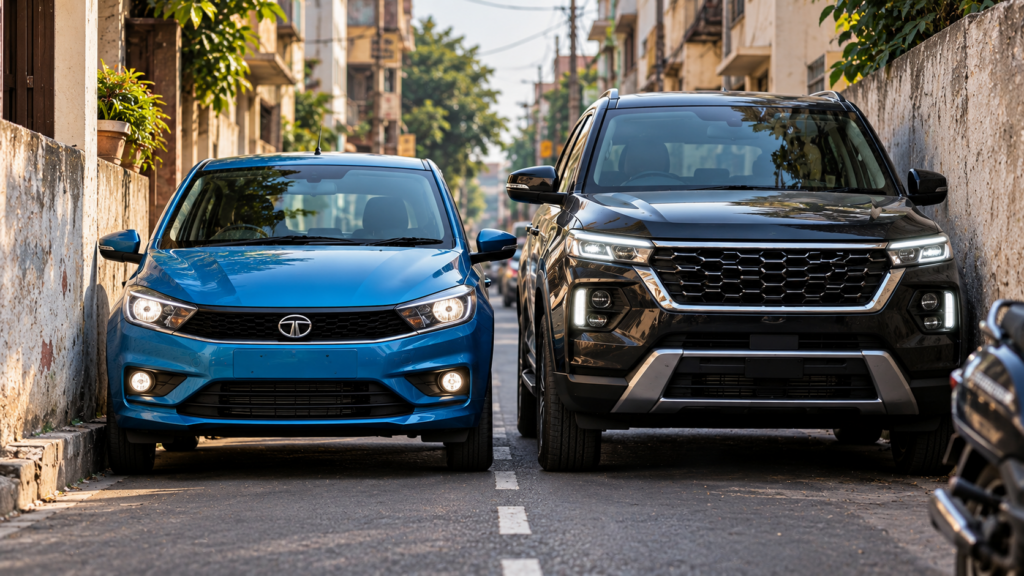
India’s car market has changed significantly over the last two decades. Hatchbacks that once dominated Indian roads are steadily losing ground to compact SUVs, with buyers increasingly attracted by their larger appearance, higher seating position and more feature-rich cabins.
But there is a practical problem that often gets overlooked: Indian roads have not grown along with Indian cars.
As vehicles become longer and wider, navigating narrow city lanes, congested markets and tight parking spaces is becoming increasingly difficult. This is where a compact hatchback such as the Tata Tiago continues to make a strong case for itself.
Indian Cars Are Getting Bigger, But Roads Aren’t
The average family car in India has grown considerably over the past few decades. According to the video, the typical family vehicle has increased from around 3.5 metres in length in the early 2000s to approximately 4.2 metres today. Average width has also increased from roughly 1.5 metres to around 1.8 metres.
Indian roads, however, have not expanded at the same pace. In several urban and residential areas, usable road space has actually become narrower because of construction, encroachments and increasing traffic.
The difference becomes obvious on narrow roads.
On a 3.5-metre-wide road, two Tata Tiagos, each approximately 1.68 metres wide, can pass one another with some clearance remaining. Larger C-segment SUVs, however, can quickly run out of space, forcing one driver to reverse before the other vehicle can pass.
This is particularly relevant in older cities, congested neighbourhoods and hilly regions where narrow roads are common.
It also explains why taxi operators and local residents in such areas continue to appreciate the practicality of small hatchbacks.
Why Hatchbacks Lost Their Aspirational Appeal
Despite their obvious advantages in crowded cities, hatchbacks have gradually lost their appeal among Indian buyers.
The problem is not necessarily the size of these cars. Instead, it is how entry-level hatchbacks have traditionally been positioned.
Many affordable cars use hard plastics, basic interiors and limited equipment to keep prices low. As a result, buyers often see a hatchback as something they have to settle for because they cannot afford a larger SUV.
Meanwhile, sub-4-metre SUVs have successfully created a much more aspirational image.
Their higher stance, aggressive styling and larger proportions make buyers feel that they are getting something substantial for their money.
The Tata Tiago attempts to challenge this perception by giving a small hatchback a more premium and feature-rich character.
Tata Tiago Brings Big-Car Features to a Small Package
Starting at around ₹4.69 lakh according to the video, the Tiago aims to make the hatchback more desirable without losing its fundamental advantages.
One of its key strengths is the cabin.
The Tiago uses fabric-based finishes to create a more premium atmosphere, rather than making the interior feel completely dominated by hard plastic surfaces.
Higher variants also receive a large 10.25-inch touchscreen infotainment system, bringing a significantly larger display to an affordable hatchback.
The car also offers a 360-degree camera with blind-view monitoring. For inexperienced drivers, this can be particularly useful when parking or navigating narrow streets.
In a country where parking spaces can be extremely tight, such technology can have much more practical value than simply being a feature on a brochure.
An Automatic Hatchback With Paddle Shifters
The Tiago also offers an AMT automatic transmission, making it easier to drive through India’s increasingly congested cities.
What makes the package more interesting is the availability of paddle shifters. This gives drivers additional control over gear changes when they want a more engaging experience.
The combination of an affordable automatic transmission and paddle shifters helps the Tiago offer something beyond the typical basic hatchback formula.
Tata has also extended its AMT technology to the Tiago iCNG. The company introduced the Tiago iCNG AMT as part of what it described as India’s first AMT CNG cars.
Safety Is Another Major Highlight
The Tiago also focuses on safety, with equipment such as six airbags, ABS, EBD, ESP and hill-hold control depending on the variant.
The platform has previously achieved a four-star Global NCAP rating, giving the Tiago additional credibility among buyers who want a compact car without completely compromising on safety.
For a city-focused hatchback, features such as electronic stability control and multiple airbags can make a meaningful difference in everyday ownership.
Why a Lightweight Hatchback Can Make Sense
Another major advantage of a hatchback is its relatively low weight.
The Tiago uses a 1.2-litre naturally aspirated petrol engine. In a lighter vehicle, the engine has less mass to move compared with the same engine installed in a considerably heavier SUV.
This can help the car feel responsive during everyday city driving.
A lighter vehicle can also require less effort from the powertrain during normal cruising, potentially helping fuel efficiency. Lower vehicle weight can additionally contribute to lower tyre and running costs.
For buyers who primarily drive within cities, these advantages can be more useful than the additional size of an SUV.
Tata’s Twin-Cylinder CNG Technology Solves the Boot-Space Problem
One of the biggest disadvantages traditionally associated with CNG hatchbacks has been boot space.
A conventional large CNG cylinder can occupy a significant portion of the luggage compartment, leaving very little room for bags.
Tata has addressed this problem with its twin-cylinder CNG technology.
Instead of using one large cylinder, the Tiago iCNG uses two smaller cylinders positioned beneath the luggage area. Tata says this arrangement allows the car to retain usable boot space while still offering the running-cost benefits of CNG.
The Tiago iCNG also offers direct CNG starting, while Tata has offered AMT technology with the CNG powertrain as well.
This makes the CNG version particularly interesting for buyers who drive long distances every day but still need a practical city car.
Why a Hatchback Still Makes Sense in 2026
The popularity of SUVs does not mean that a larger car is automatically better for every buyer.
For someone living in a crowded city, a compact hatchback can be easier to park, easier to manoeuvre and less stressful to drive through narrow streets.
Ownership costs can also be easier to manage. Affordable tyres, spare parts and routine servicing can make a noticeable difference over several years.
The argument becomes even stronger for households that already own an SUV.
A larger vehicle can be reserved for highway trips and family journeys, while a hatchback can handle daily commuting, shopping and navigating congested neighbourhoods.
The Tiago Makes the Hatchback More Desirable
The biggest challenge for hatchbacks today is not practicality. It is perception.
SUVs have managed to turn additional size and ground clearance into an aspirational advantage. The Tiago attempts to reverse that trend by making the small-car experience feel more premium.
Its combination of compact dimensions, modern technology, automatic transmission options, safety equipment and twin-cylinder CNG technology gives buyers reasons to choose a hatchback deliberately rather than simply buying one because it is cheaper.
Final Verdict
Indian cars have become bigger, but India’s roads remain crowded and, in many places, extremely narrow.
That makes the basic advantages of a hatchback more relevant than ever. A smaller footprint, easier parking, lower running costs and better manoeuvrability can be far more useful in daily city driving than the additional size of an SUV.
The Tata Tiago adds another important element to the equation by trying to make the hatchback aspirational again.
For first-time buyers, urban commuters and households looking for a practical second car, the Tiago demonstrates that choosing a smaller vehicle does not necessarily mean settling for a basic one.