
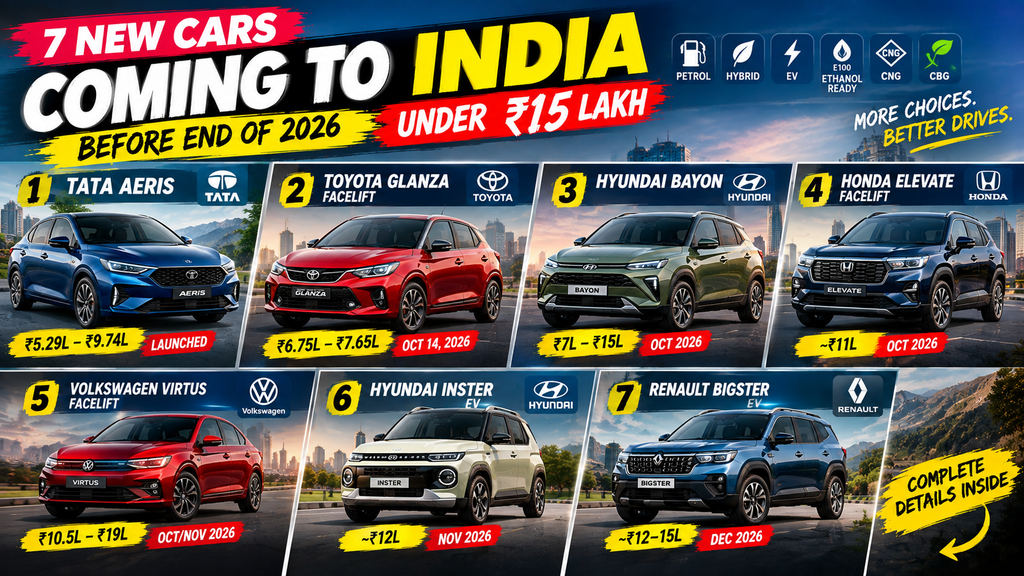
The Indian car market is set for another busy few months, with several new models and major facelifts expected to arrive before the end of 2026. From affordable compact sedans and premium hatchbacks to new SUVs and an electric city car, manufacturers are preparing products across multiple segments.
Some of these cars have already entered the market, while others are expected to launch during the upcoming festive season and towards the end of the year. Here are seven important launches to watch, with expected starting prices around or below the ₹15 lakh mark.
1. Tata Aeris
The Tata Aeris is one of the newest additions to India’s compact sedan segment and effectively replaces the Tigor nameplate in the personal-car market.
Tata has positioned the Aeris specifically for private and family buyers, rather than fleet and taxi operators. The car is available with petrol and iCNG powertrains and carries an introductory price range of ₹5.29 lakh to ₹9.74 lakh (ex-showroom).
The Aeris retains Tata’s familiar 1.2-litre naturally aspirated petrol engine, available with both manual and AMT transmissions. The iCNG version also gets an AMT option, giving buyers more flexibility.
The biggest changes are in the design and cabin. The sedan gets a heavily refreshed exterior, along with a 10.25-inch touchscreen infotainment system, digital instrument display, wireless charging and a 360-degree camera.
Safety equipment includes six airbags, while higher variants receive additional convenience and technology features.
The Aeris continues to compete with the Maruti Suzuki Dzire, Hyundai Aura and Honda Amaze, making it one of the more affordable options in the compact sedan segment.
2. Toyota Glanza Facelift
Toyota is preparing an update for its premium hatchback, with the Glanza facelift expected to debut on October 14, 2026.
The Glanza is closely related to the Maruti Suzuki Baleno, and the facelift is expected to follow the latest Baleno’s design and mechanical changes.
The updated hatchback is expected to receive a redesigned front grille, revised bumpers, updated lighting elements and new alloy wheels. The cabin is also expected to receive additional technology and convenience features.
Under the bonnet, the facelift is expected to use Maruti Suzuki’s newer 1.2-litre Z12E three-cylinder petrol engine, replacing the outgoing four-cylinder unit. Manual and AMT gearbox options are expected to continue.
The expected price range is around ₹6.75 lakh to ₹7.65 lakh, although the final prices will be announced closer to launch.
The Glanza facelift will continue to compete in the premium hatchback space against models such as the Maruti Suzuki Baleno, Hyundai i20 and Tata Altroz.
3. Hyundai Bayon
Hyundai is also preparing to expand its SUV line-up with the Bayon, a new crossover positioned between the Venue and Creta.
Bookings for the Bayon opened on September 23, 2026, with the launch expected during October. Hyundai is positioning it as an Intelligent Utility Vehicle, with technology playing a major role in its appeal.
One of the most interesting features is the built-in generative AI voice assistant, designed to allow more natural interaction between the driver and the vehicle.
The Bayon will be powered by a Hyundai petrol engine and is expected to be offered with manual and IVT automatic transmission options.
The SUV is expected to be priced in the ₹7 lakh to ₹15 lakh range, putting it directly into a highly competitive part of the Indian market.
Its crossover-style design and technology-focused cabin will allow Hyundai to target buyers looking for something positioned between a conventional compact SUV and a larger midsize SUV.
4. Honda Elevate Facelift
Honda is preparing a facelift for the Elevate, with the updated SUV expected to arrive in October 2026.
The facelift will focus primarily on design and equipment rather than introducing a completely new powertrain.
The SUV is expected to receive revised bumpers, updated lighting elements and new alloy wheels, giving the Elevate a fresher appearance.
Inside, Honda is expected to introduce several equipment upgrades. Two of the most notable additions are factory-fitted ventilated front seats and a 360-degree camera.
The existing 1.5-litre naturally aspirated petrol engine is expected to continue, paired with manual and CVT gearbox options.
The facelift is expected to start at around ₹11 lakh, although the final price will depend on the variant and equipment list.
The updated Elevate will continue to compete with SUVs such as the Hyundai Creta, Kia Seltos, Maruti Grand Vitara, Toyota Hyryder and Volkswagen Taigun.
5. Volkswagen Virtus Facelift
The Volkswagen Virtus is also due for an update, with the facelift expected around October 2026 or early November.
The updated sedan will receive cosmetic changes to its exterior along with additional equipment inside the cabin. Volkswagen is expected to bring the Virtus in line with the latest updates introduced across its India-specific MQB-A0-IN range.
The existing turbo-petrol engine family is expected to continue. This includes the 1.0-litre TSI and 1.5-litre TSI powertrains, although gearbox combinations could receive updates.
The expected price range starts at around ₹10.5 lakh, while higher variants could extend towards ₹19 lakh.
That means the Virtus does not technically have an overall price below ₹15 lakh, but its starting price remains below the ₹15 lakh mark, which puts its entry variants directly into the mainstream sedan market.
The updated Virtus will continue to compete against the Hyundai Verna, Honda City and Skoda Slavia.
6. Hyundai Inster EV
One of the more interesting upcoming electric cars is the Hyundai Inster, a small urban EV designed primarily for city driving.
Based on Hyundai’s Casper EV platform, the Inster is considerably smaller than most electric SUVs currently sold in India. Its compact dimensions should make it particularly suitable for crowded cities, narrow roads and tight parking spaces.
The India launch is expected around November 2026, with an estimated starting price of approximately ₹12 lakh.
The Inster is expected to target buyers looking for an affordable and compact electric vehicle for daily urban use.
Its expected rivals include the Tata Punch EV, Tata Tiago EV and MG Comet, although its positioning and final India specifications will determine how closely it competes with each model.
The Inster could also give Hyundai a smaller EV option below the larger Creta Electric and other upcoming electric SUVs.
7. Renault Bigster
Renault is expected to bring the Bigster to India towards the end of 2026, potentially around December.
The Bigster is positioned as a larger SUV above the Duster and is expected to offer a more spacious cabin and potentially a three-row layout for family buyers.
The SUV is expected to use a combination of petrol and hybrid powertrain options, although final India-specific specifications and seating configuration are yet to be officially confirmed.
Its expected starting price has been reported at around ₹12–15 lakh, which would make the Bigster particularly interesting if Renault can keep the entry variant competitive.
The SUV could target buyers considering larger models such as the Mahindra Scorpio-N, Mahindra XUV700 and Tata Safari, particularly their lower variants.
The Bigster would also give Renault a much larger product above the Duster and strengthen the company’s SUV portfolio in India.
2026 New Car Launches: Expected Price and Timeline
| Car | Expected/Starting Price | Expected Launch |
|---|---|---|
| Tata Aeris | ₹5.29 lakh onwards | Launched |
| Toyota Glanza Facelift | ₹6.75 lakh onwards | October 14, 2026 |
| Hyundai Bayon | ₹7 lakh onwards | October 2026 |
| Honda Elevate Facelift | Around ₹11 lakh onwards | October 2026 |
| Volkswagen Virtus Facelift | Around ₹10.5 lakh onwards | October/November 2026 |
| Hyundai Inster EV | Around ₹12 lakh | November 2026 |
| Renault Bigster | Around ₹12–15 lakh | December 2026 |
Prices and launch timelines for upcoming models are expected figures and can change before official announcements.
A Busy End to 2026 for the Indian Car Market
The remaining months of 2026 are expected to bring a wide variety of new vehicles to Indian buyers.
The Tata Aeris brings a fresh option to the compact sedan segment, while the Toyota Glanza facelift and Volkswagen Virtus facelift will refresh two established nameplates.
Hyundai is preparing two very different products with the Bayon and Inster EV, while Honda will update the Elevate with additional technology and convenience features.
At the larger end of the list, the Renault Bigster could bring a more spacious SUV option at a price point aimed at mainstream buyers.
With several of these launches scheduled around the festive season, buyers looking for a new car in the coming months will have multiple new options to consider across petrol, hybrid and electric segments.