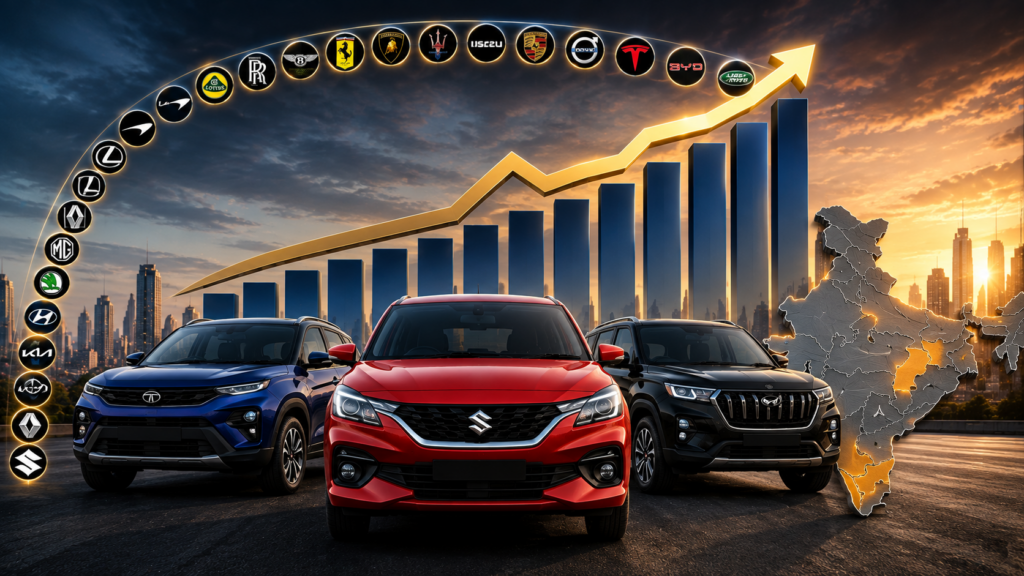
India’s passenger vehicle market continued to show a major shift in consumer preferences during August 2026, with petrol, diesel, CNG, hybrid and electric vehicles all competing for buyers. While manufacturer wholesale sales remained strong during the month, registration data provides another perspective on what customers were actually choosing across different brands and powertrains.
The August registration figures reveal one particularly clear trend: Maruti Suzuki continues to dominate the Indian market by a massive margin, while Tata Motors and Mahindra remain the strongest challengers. The data also highlights how differently manufacturers are positioned when it comes to CNG, hybrid and electric vehicles.
Maruti Suzuki Maintains a Huge Lead
Maruti Suzuki remained comfortably ahead of every other manufacturer in the August registration rankings, with the supplied registration data putting the company at around 1.41 lakh units.
The most interesting part of Maruti’s performance is its strong CNG contribution. The brand recorded approximately 51,934 CNG registrations, demonstrating just how important factory-fitted CNG vehicles remain for Indian buyers.
Maruti’s extensive CNG portfolio gives it a major advantage in this area, particularly among customers looking for low running costs without switching completely to an electric vehicle.
The company’s electric offering also recorded around 1,338 registrations, while Toyota’s rebadged equivalent was reported at only 161 units. Maruti also registered two flex-fuel Wagon R units and one diesel vehicle.
Maruti’s combination of affordable petrol cars, a huge CNG portfolio, SUVs and newer electric products continues to give it an unusually broad reach across the Indian market.
Tata Motors Holds Second Position
Tata Motors occupied the second position with approximately 55,600 registrations in the supplied data.
Unlike Maruti, Tata has built a particularly diverse powertrain portfolio. Its August numbers included roughly:
- 20,626 petrol vehicles
- 12,500 electric vehicles
- 6,318 diesel vehicles
- 1,654 CNG vehicles
The company’s electric vehicle volume stands out. Tata has one of India’s largest EV portfolios, covering models such as the Punch EV, Nexon EV, Curvv EV and other electric offerings.
At the same time, Tata continues to maintain diesel engines across several SUVs despite relatively weaker diesel volumes compared with petrol and electric vehicles.
Industry wholesale data also confirms Tata’s strong August performance, with domestic passenger vehicle sales reaching 65,253 units, up 59 percent year on year.
Mahindra Strengthens Its Position
Mahindra followed Tata with approximately 47,671 registrations.
The company’s biggest strength continues to be diesel SUVs. Around 35,000 units of its registrations were attributed to diesel vehicles, underlining the continuing demand for diesel powertrains among buyers of larger SUVs and utility vehicles.
Mahindra’s electric portfolio is also becoming increasingly important, contributing approximately 6,358 registrations.
This combination of traditional diesel SUVs and new-generation electric models gives Mahindra a distinctive position in the market. The company does not have the enormous CNG presence of Maruti or the breadth of Tata’s EV portfolio, but its strong SUV lineup continues to attract customers.
Mahindra also reported strong wholesale performance in August, with domestic passenger vehicle sales of 59,257 units, representing 50 percent year-on-year growth.
Hyundai Remains India’s Fourth-Largest Major Player
Hyundai recorded approximately 42,659 registrations, retaining its position among India’s biggest car manufacturers.
Its fuel mix remained heavily petrol-oriented, although the company also recorded around 9,340 diesel, 5,500 CNG and 800 electric registrations.
Hyundai’s relatively balanced portfolio allows it to compete across several important segments, from hatchbacks and compact SUVs to larger SUVs and electric vehicles.
The company’s official August domestic sales were also strong, reaching 54,396 units, up 23.6 percent compared with August 2025. Hyundai described the figure as its highest-ever August domestic sales performance.
Kia and Toyota Battle for the Next Spot
Kia recorded approximately 22,762 registrations, with petrol remaining its dominant fuel type.
The supplied breakdown includes:
- 14,425 petrol
- 7,801 diesel
- 531 electric
- 5 CNG
The extremely low CNG contribution is unsurprising given Kia’s limited factory-fitted CNG presence in India.
Toyota, meanwhile, recorded approximately 21,665 registrations and showed a very different fuel mix.
Around 9,841 units were hybrids, making hybrid technology a major part of Toyota’s Indian sales strategy. Petrol accounted for approximately 4,654 units, diesel for around 4,427 units and CNG for roughly 2,500 units.
The contrast between Toyota and Kia demonstrates how strongly different powertrain strategies can influence a manufacturer’s sales mix.
JSW MG Motor Shows the Strength of EVs
JSW MG Motor recorded approximately 5,646 registrations.
What makes its numbers particularly interesting is the dominance of electric vehicles. Around 4,496 registrations were electric, compared with approximately 681 petrol and 469 diesel vehicles.
That means EVs represented the overwhelming majority of the registrations attributed to the brand in the supplied data.
MG’s growing EV focus places it in a very different position from traditional manufacturers that still depend heavily on petrol or diesel models.
Honda and Renault Remain More Petrol-Focused
Honda recorded approximately 4,749 registrations, with petrol models accounting for the vast majority. Around 121 hybrid vehicles were attributed to the brand, largely representing the City e:HEV.
Renault, meanwhile, registered approximately 3,196 units, of which almost all were petrol vehicles. The supplied data records only one CNG registration.
The lack of factory-fitted CNG options remains a significant disadvantage for Renault in a market where low running costs are an increasingly important consideration.
Nissan Leads the Smaller Mainstream Brands
Nissan recorded approximately 2,725 registrations, almost entirely made up of petrol vehicles.
The supplied breakdown includes around 2,713 petrol and just 12 CNG vehicles.
Below Nissan, the numbers fall sharply. Citroen recorded around 776 registrations, VinFast 750 and Jaguar Land Rover 549.
BYD registered approximately 537 units, reflecting the growing presence of Chinese EV manufacturers in India’s premium electric vehicle market.
Luxury Brands Remain Highly Niche
The registration data also highlights just how small India’s ultra-luxury car market remains.
Porsche recorded 57 units, Volvo 110, Tesla 111 and Isuzu 36. Lamborghini and Maserati registered four units each, while Bentley and Ferrari recorded three units apiece.
Rolls-Royce registered just one vehicle.
The supplied data also records zero registrations for Lexus, McLaren and Lotus during August.
While these numbers are tiny compared with mainstream manufacturers, they demonstrate the extremely niche nature of India’s super-luxury and exotic car market.
What the Fuel Mix Tells Us
Perhaps the most interesting takeaway from the August registration data is that there is no single powertrain dominating every manufacturer.
Maruti’s biggest advantage remains CNG, Toyota has built a strong hybrid position, Tata is pushing aggressively into EVs, Mahindra continues to rely heavily on diesel while expanding its EV portfolio, and MG is becoming increasingly electric-focused.
This suggests that India’s transition away from conventional petrol and diesel vehicles is not happening in a simple, uniform manner.
Instead, consumers are choosing different technologies depending on their budget, driving patterns, infrastructure availability and expectations around running costs.
Registrations vs Wholesale Sales: Why the Numbers Can Differ
It is important to distinguish registration figures from manufacturer wholesale or dispatch numbers.
Industry reports published after August showed domestic passenger vehicle wholesale volumes at roughly 4.5 lakh units, representing around 35–36 percent year-on-year growth. Maruti’s domestic passenger vehicle sales were reported at 176,971 units, while Tata and Mahindra recorded 65,253 and 59,257 units respectively.
Registration data, on the other hand, reflects vehicles registered with authorities and can differ because of inventory timing, dealer stock, regional registration patterns and other factors.
Therefore, the supplied ranking should be viewed specifically as a registration-based snapshot, rather than a direct comparison of manufacturer dispatches.
The Bigger Picture for Indian Car Buyers
August 2026 shows that India’s automotive market is becoming increasingly diverse.
Maruti Suzuki continues to dominate through sheer scale and its enormous CNG portfolio. Tata is aggressively expanding its EV presence, Mahindra is combining powerful diesel SUVs with new electric models, Toyota remains a leader in hybrids, while MG is building a strong electric identity.
At the premium end, meanwhile, the numbers remain tiny, with exotic brands selling only a handful of vehicles each month.
The biggest story is therefore not simply which company sold the most cars. It is how different manufacturers are positioning themselves for India’s changing powertrain landscape.
For buyers, that means the decision is no longer simply between petrol and diesel. CNG, strong hybrids, plug-in technology and EVs are increasingly becoming part of the mainstream conversation—and the August 2026 registration mix shows that Indian consumers are already choosing different paths depending on their needs.