
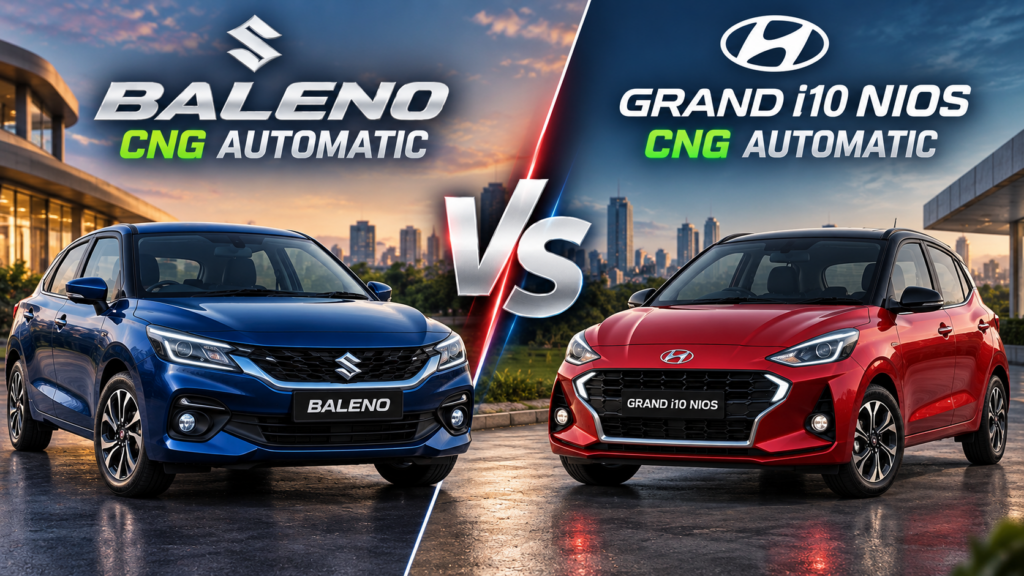
The Indian hatchback market could be heading toward an interesting new rivalry as Maruti Suzuki prepares to strengthen the Baleno CNG lineup while Hyundai continues to offer the Grand i10 Nios with CNG technology. The biggest talking point could be the arrival of automatic CNG versions, combining low running costs with the convenience of an automatic gearbox.
While Hyundai already has an advantage with its refined four-cylinder engine and practical CNG packaging, Maruti could counter with better fuel efficiency, a larger cabin and its strong reputation for affordable ownership.
Four-Cylinder Refinement vs Three-Cylinder Efficiency
One of the biggest differences between the two cars could be their engine configurations.
The Hyundai Grand i10 Nios uses a four-cylinder petrol engine, which gives it a smoother and more refined character. The additional cylinder helps reduce engine vibrations and harshness, particularly at idle and during low-speed driving. This makes the Nios particularly appealing to buyers who value a quiet and comfortable city car.
The upcoming Maruti Suzuki Baleno CNG Automatic, meanwhile, is expected to use Maruti’s newer three-cylinder Z-Series engine. A three-cylinder engine may not match the Nios for outright refinement, but the lighter engine and overall lower vehicle weight could help improve fuel efficiency.
For CNG buyers, this difference is particularly important. These customers typically prioritize running costs over outright performance, making efficiency one of the Baleno’s biggest potential advantages.
CNG Packaging Could Become a Major Differentiator
CNG cars have traditionally had one major compromise: boot space.
A large CNG cylinder can occupy a significant portion of the luggage compartment, making it difficult for owners to carry luggage when the car is fully occupied.
Hyundai has already addressed this issue on the Grand i10 Nios by using an under-body CNG tank arrangement. This allows the hatchback to retain a more practical boot while still offering the lower running costs associated with CNG.
Maruti is expected to respond with a similar integrated CNG setup for the Baleno. If the Baleno gets an under-body CNG tank while retaining its larger premium-hatchback dimensions, it could become a particularly attractive option for families who need both efficiency and usable luggage space.
The AMT Automatic Battle
The automatic transmission could become another important battleground.
Both manufacturers are expected to rely on AMT gearboxes rather than more expensive automatic technologies. This approach helps keep purchase prices under control while maintaining the efficiency advantage that CNG buyers are looking for.
However, the actual driving experience will depend heavily on gearbox calibration.
AMTs can sometimes produce noticeable jerks during gear changes, particularly in stop-and-go traffic. The manufacturer that delivers smoother shifts, quicker responses and better low-speed calibration could have a clear advantage in congested Indian cities.
This is an area where Hyundai has already developed a strong reputation, while Maruti’s lightweight cars and simple AMT systems have also proved popular among urban buyers.
Baleno’s Size Gives It a Major Advantage
The Baleno has traditionally held an advantage over the Grand i10 Nios in terms of overall size.
The Baleno measures around 3.99 metres in length with a 2.52-metre wheelbase, while the Grand i10 Nios measures around 3.82 metres with a 2.45-metre wheelbase.
That difference translates into a more spacious overall package, particularly for families who frequently carry multiple passengers.
The Baleno therefore sits closer to the premium hatchback category, while the Nios focuses more strongly on compact dimensions and easy city manoeuvrability.
However, Hyundai could change the equation if reports of a larger next-generation Grand i10 Nios prove accurate.
Hyundai Could Fight Back With a Larger Nios
If Hyundai increases the dimensions of the next-generation Nios, it could directly challenge one of the Baleno’s biggest advantages.
A larger body could provide additional rear-seat space and improve the overall cabin experience while maintaining the Nios’s relatively compact footprint.
This would allow Hyundai to target buyers who currently choose the Baleno primarily because they want a spacious hatchback without moving into a larger or more expensive car.
The success of such a move would ultimately depend on pricing. A larger, better-equipped Nios with CNG and an automatic transmission could become a serious alternative to the Baleno.
Cabin Quality Could Favour Hyundai
When it comes to interior presentation, Hyundai has traditionally focused heavily on creating a premium cabin experience.
The Grand i10 Nios benefits from a well-finished dashboard, modern screen layout and a generally upmarket ambience. The cabin feels designed to appeal to buyers who want their affordable hatchback to feel more sophisticated.
The Baleno, on the other hand, focuses more heavily on practicality and space. Its cabin is functional and spacious, but Hyundai has historically had an edge in perceived interior quality.
For buyers who spend several hours every day in traffic, this difference could become an important deciding factor.
Baleno Could Win on Running Costs
The biggest potential advantage for the Baleno CNG Automatic is fuel efficiency.
The current manual Baleno CNG is claimed to deliver 30.61 km/kg, giving it an extremely strong efficiency figure. The combination of a lightweight body and a smaller three-cylinder engine could help the automatic version remain highly economical as well.
The Grand i10 Nios also benefits from Hyundai’s efficient CNG technology, but the Baleno’s lighter construction could give Maruti an advantage when it comes to overall running costs.
This could be particularly important for buyers who drive long distances every month and plan to keep the car for several years.
Which One Could Be Better?
The answer will ultimately depend on what buyers value most.
The Hyundai Grand i10 Nios CNG Automatic could be the better choice for buyers who prioritize:
- Smooth and refined engine performance
- A premium-looking cabin
- Easy city driving
- Compact dimensions
- Comfortable everyday usability
The Maruti Suzuki Baleno CNG Automatic, meanwhile, could appeal more strongly to buyers who want:
- Maximum fuel efficiency
- A larger cabin
- Better family practicality
- Usable luggage space
- Lower long-term running costs
The current Grand i10 Nios lineup already offers petrol and CNG options, along with AMT automatic versions in its petrol range.
Pricing Could Decide the Winner
Ultimately, the biggest factor could be pricing.
CNG buyers are generally highly conscious of running costs, but they are also sensitive to the initial purchase price. If Maruti can introduce the Baleno CNG Automatic at an aggressive price while maintaining its efficiency and spacious cabin, it could become a compelling package.
Hyundai, meanwhile, would need to maintain the Nios’s refinement advantage while ensuring that an automatic CNG version does not become too expensive.
If Hyundai also increases the Nios’s dimensions and improves its overall package, the competition could become even closer.
Final Verdict
The potential Baleno CNG Automatic vs Grand i10 Nios CNG Automatic battle could create a new choice for buyers who want the convenience of an automatic without giving up the low running costs of CNG.
The Baleno’s larger dimensions, lighter construction and efficiency could make it the more practical family choice, while the Nios could continue to attract buyers with its smoother four-cylinder engine and premium cabin experience.
If Hyundai successfully combines a larger Nios with improved CNG packaging and competitive pricing, however, it could seriously challenge Maruti’s dominance in the premium hatchback space.
For now, the battle appears to be shaping up around a simple question: maximum efficiency and space, or refinement and premium feel?